Something has shifted in how serious businesses think about marketing. The conversation has moved from “should we try AI?” to “which AI-powered approach is actually building us results?” Across industries, from ecommerce startups to established B2B brands, the migration toward the best AI digital marketing agency model is accelerating — and it is not a trend driven by hype. It is driven by measurable outcomes that traditional agencies are struggling to match.
This guide breaks down exactly why that shift is happening, what AI marketing agencies actually do differently, and how to evaluate whether making the switch makes sense for your business right now.
What Is an AI Digital Marketing Agency?
An AI digital marketing agency is not simply a traditional agency that bought a ChatGPT subscription. The distinction matters enormously when you are evaluating where to put your budget. True AI-powered agencies have rebuilt their core workflows, data infrastructure, and campaign execution around machine learning, predictive analytics, and automation systems that operate at a speed and precision no human team can replicate manually.
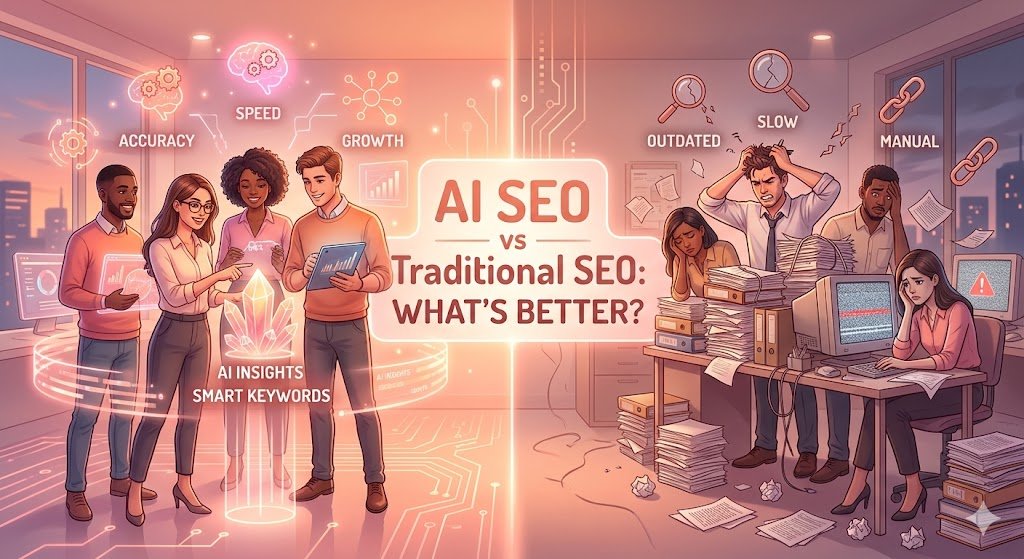
Where a traditional agency relies on analyst intuition, spreadsheet reviews, and monthly reporting cycles, the best AI digital marketing agency uses real-time data pipelines, algorithmic optimization, and predictive modeling that adjusts campaigns while they are running — not after the budget has already been spent on underperforming audiences, keywords, or creative.
How AI Marketing Agencies Differ From Traditional Ones
- Traditional agencies make decisions based on historical data reviewed weekly or monthly; AI agencies make decisions based on live performance signals reviewed in real time, often autonomously, with human strategists setting parameters rather than manually adjusting every variable
- Traditional agencies scale output by hiring more people; AI agencies scale by deploying more compute, which means the cost-to-output ratio improves as you grow rather than increasing linearly with headcount
- Traditional creative processes rely on human brainstorming cycles that take days or weeks; AI-powered creative workflows generate, test, and iterate on dozens of creative variants simultaneously, compressing testing timelines from months to days
- Traditional reporting tells you what happened; AI-powered analytics tells you what is happening right now, what is likely to happen next, and which lever to pull to change the outcome before the budget is already spent
The Technology Stack Behind AI Marketing
The best AI digital marketing agency builds its operational advantage on a technology stack that most businesses could not afford or maintain independently. This includes natural language processing for content generation and semantic SEO, machine learning models for bid optimization and audience targeting, computer vision for creative performance prediction, and predictive analytics platforms that model customer lifetime value, churn probability, and purchase timing at the individual customer level.
Why Businesses Are Switching to AI Marketing: The Real Reasons
The switch is not happening because AI is fashionable. It is happening because specific, measurable pain points of traditional marketing are being solved by AI approaches in ways that compound over time and create advantages that are increasingly difficult for non-AI competitors to close.
The Speed Problem Traditional Agencies Cannot Solve
Marketing in 2026 moves faster than human teams can manually manage. Consumer behavior shifts within hours of a news event, platform algorithms update without notice, and competitor positioning changes overnight. Traditional agencies, no matter how talented their team, are limited by the speed of human decision-making — weekly calls, monthly reports, and campaign adjustments that lag the market by weeks.
AI-powered marketing strategies eliminate that lag almost entirely. When a creative starts fatiguing, the system detects it and rotates to the next variant. It’s when a keyword cluster starts converting below target, bids are adjusted automatically. When a customer segment shows early churn signals, retention campaigns are triggered before the customer has consciously decided to leave. The best AI digital marketing agency turns marketing from a reactive function into a predictive one, and that shift alone is worth the switch for most growth-stage businesses.
The Personalization Gap
Buyers in 2026 expect experiences personalized to their specific behavior, preferences, and stage in the purchase journey. Traditional marketing delivers segment-level personalization at best — “women aged 25 to 34 who like fitness” — which is a crude approximation of the individual-level understanding that actually drives conversion.
AI digital marketing agencies deliver genuine one-to-one personalization at scale. Every email, every retargeting ad, every on-site recommendation can be dynamically tailored to the individual’s behavioral history, predicted next purchase, and real-time context. The best AI digital marketing agency does not just segment your audience into ten buckets — it treats each customer as their own segment and optimizes every touchpoint accordingly.
The Data Utilization Problem
Most businesses are sitting on more customer data than they know what to do with. Purchase history, browse behavior, email engagement patterns, ad interaction data, customer service records — the data exists, but traditional marketing teams lack the infrastructure to synthesize it into actionable intelligence at the speed the market demands.
AI marketing solutions for businesses are built specifically to operationalize that data. Machine learning models find patterns in customer behavior that human analysts would never identify manually. Predictive LTV models determine which newly acquired customers are worth aggressive retention investment and which are likely one-time buyers. Churn prediction models surface at-risk customers before they leave rather than after. The best AI digital marketing agency turns your data from a reporting archive into a live strategic asset.
Benefits of AI in Digital Marketing: What the Numbers Actually Show
The benefits of AI in digital marketing are not theoretical. Businesses that have made the transition are reporting concrete performance improvements across every major marketing metric.
Efficiency Gains Across Paid Advertising
- AI-powered bid management reduces wasted ad spend by 20 to 40 percent on average by eliminating the manual latency between performance signal and bid adjustment that plagues human-managed campaigns
- Automated audience optimization continuously refines targeting parameters based on conversion data, shifting spend toward the segments, devices, times, and placements that are actually producing revenue rather than those that looked promising in the original strategy brief
- Creative performance prediction using computer vision can evaluate which visual and copy elements in an ad are most likely to drive click-through and conversion before the ad even runs, reducing the cost and time of creative testing cycles significantly
- Dynamic budget allocation across campaigns and channels based on real-time performance means your total media budget is always flowing toward the highest-return opportunities available at any given moment
Content Production at Scale Without Sacrificing Quality
AI content marketing services have moved far beyond generating mediocre blog posts. The best AI digital marketing agency uses AI to identify content opportunities through semantic gap analysis, generate structured content briefs grounded in search intent data, produce first drafts optimized for both reader experience and search engine signals, and personalize that content across multiple audience segments and distribution channels simultaneously.
The human role in this workflow shifts from execution to strategy and quality control — a division of labor that produces significantly more content at significantly higher average quality than either purely human or purely automated approaches alone.
Email Marketing Automation That Actually Personalizes
AI email marketing automation goes well beyond the triggered sequences that most ecommerce stores already have. The best AI digital marketing agency builds email programs where send time is optimized individually for each subscriber based on their historical open behavior, subject lines are dynamically tested and selected by predicted open rate, product recommendations inside emails are generated from individual browsing and purchase data rather than general bestseller lists, and send frequency is adjusted per subscriber based on engagement signals to maximize revenue while minimizing unsubscribes.
The performance difference between traditional batch-and-blast email and AI-personalized email is not marginal. Stores making this transition typically see 30 to 60 percent improvements in email revenue from the same list size.
AI-Powered Marketing Strategies That Are Working Right Now
The future of AI in marketing is already present in the strategies the best AI digital marketing agency deploys for clients today. Here is what those strategies look like in practice.
AI SEO Services: Beyond Keyword Stuffing
AI SEO services have transformed what search optimization actually means. Traditional SEO focused on keyword density, backlink counts, and technical checklists. AI-powered SEO focuses on semantic relevance, topical authority mapping, search intent satisfaction, and content quality signals that align with how modern search engines actually evaluate and rank pages.
- Semantic keyword clustering that groups related terms by intent rather than by literal word match, enabling content strategies that build genuine topical authority rather than targeting isolated keywords in isolation
- Automated technical SEO monitoring that identifies and prioritizes issues based on their projected revenue impact rather than treating every crawl error as equally urgent regardless of the page’s actual commercial importance
- Content gap analysis using AI to identify the specific questions, entities, and topics your site is not covering that your competitors are ranking for, giving content teams a prioritized roadmap grounded in real search demand data
- SERP feature optimization targeting featured snippets, People Also Ask placements, and AI Overviews that are increasingly capturing the clicks that traditional blue-link rankings used to deliver
AI PPC Optimization: Smarter Spend at Every Level
AI PPC optimization is the service where the performance gap between AI-powered and traditional management is most immediately visible and most directly measurable in revenue terms.
- Smart bidding strategy configuration and oversight that goes beyond accepting platform defaults to actively shape how automated bidding systems behave, what signals they weight, and what constraints protect your profitability
- Auction insight analysis and competitive response modeling that adjusts your positioning dynamically as competitor behavior changes, rather than waiting for a monthly review to notice that your impression share has declined
- Ad copy generation and multivariate testing at a scale that human copywriters cannot match, running dozens of headline and description combinations simultaneously and retiring underperformers based on statistical significance rather than gut instinct
- Conversion value optimization that moves beyond ROAS as a flat metric toward optimizing for the specific customer segments and product combinations that deliver your highest lifetime value, not just your highest immediate transaction value
Social Media Marketing which is AI powered: From Posting to Predicting
AI social media marketing changes the fundamental nature of what social media management means for a brand. The best AI digital marketing agency does not just schedule posts and respond to comments — it uses AI to predict content performance before publishing, identify trending topics and sounds before they peak, optimize posting times at the individual follower level, and analyze competitor content strategies in real time.
- Sentiment analysis monitoring across every platform and every mention of your brand or category that surfaces both crisis signals and opportunity signals before they become obvious to competitors watching the same space manually
- AI-generated creative variants for paid social that test visual styles, messaging angles, and audience combinations systematically rather than relying on creative intuition and the limited testing bandwidth of human-managed campaigns
- Influencer identification algorithms that evaluate creator audiences for genuine engagement quality, audience-product fit, and conversion potential rather than follower count, eliminating the expensive guesswork of traditional influencer selection
- Organic content performance prediction that uses historical engagement data to forecast which content formats, topics, and posting windows will perform strongest before committing production resources to full-scale content creation
Who Is Switching — and Why Now
The businesses making the switch to AI digital marketing agencies in 2026 span every category and revenue stage. The common thread is not industry or company size — it is the recognition that the performance gap between AI-powered and traditional marketing is widening fast enough that waiting has become expensive.
E-commerce Brands Scaling Past Their Traditional Agency
Ecommerce businesses are among the earliest and most aggressive adopters of AI marketing solutions for businesses because the feedback loops are fast, the data is rich, and the revenue impact is directly measurable. Affordable AI digital marketing solutions for ecommerce have become a genuine option for brands at every scale — the technology that required enterprise budgets three years ago is now accessible to stores doing $500K annually.
The best AI digital marketing agency for ecommerce integrates directly with your store data, your ad platforms, your email system, and your customer database to build a unified optimization layer that improves performance across every channel simultaneously. That integration is what separates genuine AI-powered agencies from traditional agencies with AI tools bolted on as an afterthought.
B2B Companies Dealing With Longer Sales Cycles
B2B marketing is a natural fit for AI because the complexity of the buyer journey — multiple touchpoints, multiple stakeholders, long evaluation periods — is exactly the kind of multi-dimensional problem that machine learning handles better than human intuition.
AI-powered marketing strategies for B2B use behavioral scoring to identify which prospects are showing genuine buying intent versus casual research interest, optimize content nurture sequences for individual stakeholder roles, and predict deal probability based on engagement pattern signals that human marketing teams track too imprecisely to act on effectively.
Startups That Cannot Afford to Waste Budget
The case for best AI-powered digital marketing services for startups is particularly compelling because startups cannot afford the inefficiency of traditional marketing. Every dollar of acquisition budget needs to work as hard as possible, every creative needs to be tested and optimized quickly, and the team is too lean to manually manage complex multi-channel campaigns at the depth of attention they require.
The best AI digital marketing agency gives startups access to marketing infrastructure and analytical sophistication that would otherwise require a 10-person marketing team — at a fraction of the cost, and with the speed advantage that startups need to compete against established players with larger brand budgets.
How AI Digital Marketing Agencies Help Businesses Scale
Scaling marketing with a traditional agency means hiring more people, creating more content manually, and managing more complexity with the same fundamental processes just applied to larger budgets. Scaling with the best AI digital marketing agency means deploying more compute, expanding your data inputs, and letting the AI layer handle the operational complexity that human teams would otherwise need to staff for.
From Manual Campaigns to Autonomous Optimization
The shift from manually managed campaigns to AI-optimized ones is not just an efficiency gain — it is a structural change in how marketing operates. When your campaigns are optimizing autonomously based on real-time performance signals, your marketing team stops spending time on operational management and starts spending time on strategy, creative direction, and business-level decision-making.
That shift compounds over time. The best AI digital marketing agency builds systems that get smarter with every dollar spent, every email sent, and every customer interaction captured — creating a proprietary optimization advantage that grows more powerful as your business scales rather than requiring proportionally more human input to maintain.
Predictive Analytics for Smarter Growth Decisions
- Customer lifetime value prediction at the individual level that informs how much you can afford to spend acquiring different customer segments, transforming acquisition decisions from averages into precise, segment-specific bets
- Demand forecasting that anticipates sales volume by product, category, and channel so your marketing spend can front-load into the windows where it will have the most impact rather than distributing evenly across periods of unequal commercial opportunity
- Churn prediction models that identify at-risk customers 30 to 90 days before they would typically lapse, enabling retention interventions at the moment when reactivation is least expensive and most likely to succeed
- Product affinity modeling that reveals which product combinations drive the highest repeat purchase rates and LTV, informing both your merchandising strategy and your post-purchase email and retargeting sequences
Multi-Channel Orchestration at Scale
The best AI digital marketing agency orchestrates your paid, organic, email, social, and content channels as a unified system rather than a collection of independent campaigns. When a customer sees your Instagram ad, visits your product page, browses for three minutes and leaves without purchasing, the AI system triggers the appropriate retargeting sequence, adjusts the email timing and content for that specific behavioral signal, and reduces paid retargeting frequency as email engagement grows — all without manual intervention.
That level of cross-channel coordination is operationally impossible for human teams managing campaigns at any meaningful scale. It is the standard operating mode for AI-powered agencies, and it is one of the most tangible performance advantages the switch delivers.
The Future of AI in Marketing: What Is Coming Next
The future of AI in marketing is not a distant projection — much of it is already deployed at leading AI digital marketing agencies today. Understanding the trajectory helps businesses make smarter decisions about when and how to make the transition.
Generative AI Creative at Production Scale
Generative AI for marketing creative has moved from novelty to production infrastructure. The best AI digital marketing agency is already using generative models to produce hundreds of ad creative variants, personalized landing page versions, and dynamic email content blocks that adapt to individual recipient context. The creative work that previously required weeks of production time and significant agency creative fees is compressed into hours, with human art direction and brand governance maintaining quality control over AI output.
Conversational AI for Customer Acquisition
AI-powered chat experiences are evolving from basic FAQ bots into genuine conversion tools. Conversational AI that understands purchase intent, surfaces the right product for the right buyer, handles objections with personalized responses, and hands off to human agents only when genuinely necessary is becoming a standard component of high-performing ecommerce and B2B marketing stacks. Top-rated AI digital marketing companies are already integrating these capabilities into their client growth systems.
Predictive Creative Optimization
The next evolution of creative testing is not A/B testing — it is predictive creative optimization, where AI evaluates new creative assets against historical performance patterns and audience behavioral data to predict performance before the ad runs. This eliminates the cost of running underperforming creative long enough to gather statistical significance and accelerates the identification of breakthrough creative concepts that would otherwise take months of testing to surface.
How to Choose the Best AI Digital Marketing Agency
Not every agency calling itself AI-powered has built genuine AI capability into their operations. The gap between agencies using AI tools and agencies that have rebuilt their workflows around AI infrastructure is significant — and knowing how to evaluate the difference will protect your budget and your growth timeline.
Questions That Reveal Real AI Capability
- Ask specifically how their AI systems are integrated into campaign management — which decisions are made autonomously, which require human approval, and what the feedback loop looks like between performance data and system adjustment
- Ask for concrete examples of how their AI capability has improved a specific client outcome — not general claims about AI efficiency, but a specific account, a specific problem, and a specific measurable result that AI produced
- Ask what happens when the AI makes a wrong decision — what guardrails exist, how quickly errors are caught, and who is accountable for maintaining the quality control that prevents automated systems from running bad campaigns at machine speed
- Ask about data ownership — who owns the models trained on your customer data, what happens to that data if you end the relationship, and how your proprietary data is protected from being used to optimize other clients’ campaigns
Signs You Are Looking at the Best AI Digital Marketing Agency
The best AI digital marketing agency demonstrates its capability through transparency, not just claims. They show you the actual dashboards their AI systems produce, explain the logic behind automated decisions in terms you can evaluate, and give you a clear picture of where human judgment begins and ends in their workflow.
They also have specific ecommerce or industry expertise alongside their AI capability. Hire AI digital marketing services from an agency that combines genuine machine learning infrastructure with deep knowledge of your specific market — because AI applied without strategic context produces optimized campaigns pointed in the wrong direction.
Red Flags in AI Marketing Agency Claims
- Agencies that cannot explain their AI methodology in concrete terms, defaulting to vague language about “proprietary algorithms” without being able to describe what those algorithms actually optimize for or how
- AI marketing solutions for businesses that are actually just third-party tools like ChatGPT and standard platform smart bidding repackaged as a proprietary AI offering with a premium price tag attached
- No human strategists visible in the team structure — fully automated agencies without experienced marketing practitioners overseeing strategy and quality are a significant risk because AI without strategic direction optimizes efficiently toward the wrong goals
- Promises of results that ignore the data requirements genuine AI optimization needs — AI performs better as it accumulates data, which means unrealistic promises about immediate AI-driven results typically signal a gap between the agency’s marketing and their actual capability
Affordable AI Digital Marketing Packages: What to Expect at Different Budgets
One of the most persistent misconceptions about working with the best AI digital marketing agency is that the technology makes it more expensive than traditional marketing. In practice, the efficiency gains AI produces often make it more affordable on a cost-per-result basis even when the monthly retainer is comparable.
Entry-Level AI Marketing ($1,500 – $4,000/month)
At this tier, affordable AI digital marketing packages typically cover one or two primary channels — usually paid advertising with AI bid optimization and email marketing with AI-driven automation and personalization. The AI infrastructure is shared across the agency’s client base rather than custom-built for your account, but the performance advantage over manual management is still significant and measurable.
This is the right entry point for best AI-powered digital marketing services for startups and early-stage ecommerce brands that need to prove ROI before committing to broader channel investment.
Mid-Market AI Marketing ($4,000 – $12,000/month)
At this tier, the best AI digital marketing agency delivers multi-channel AI optimization across paid ads, SEO, email, and social — with more sophisticated attribution modeling, custom audience segmentation, and predictive analytics specific to your customer data. Human strategists at this level are actively interpreting AI outputs and making business-level recommendations rather than purely managing campaign operations.
This is where affordable AI digital marketing solutions for ecommerce brands in the $1M to $10M revenue range deliver their strongest ROI, particularly when the agency has ecommerce-specific AI infrastructure rather than generic digital marketing tools.
Enterprise AI Marketing ($12,000+/month)
Enterprise AI marketing engagements with a top-rated AI digital marketing company include fully custom AI model development, proprietary data infrastructure, advanced attribution and media mix modeling, and AI orchestration across every marketing channel including offline and retail. The agency functions as an embedded AI marketing capability rather than an external service provider.
Making the Switch: A Practical Transition Plan
Switching to the best AI digital marketing agency does not require rebuilding your entire marketing operation overnight. The most successful transitions follow a sequenced approach that establishes data infrastructure first, migrates channels in order of ROI impact, and builds internal familiarity with AI-powered reporting before full dependence on automated systems.
Phase One — Data Foundation and Audit
Before AI can optimize anything, it needs clean, complete, and connected data. The first phase of any serious AI marketing engagement involves auditing your existing tracking infrastructure, connecting your ad platforms, CRM, email system, and ecommerce store into a unified data layer, and establishing the attribution model that will govern how results are measured.
This phase typically takes four to eight weeks and feels slow relative to the results it eventually enables. Skipping it is the most common reason AI marketing engagements underperform — the systems are only as good as the data they are trained on, and garbage data produces confidently wrong optimization.
Phase Two — Channel Migration by ROI Priority
- Paid advertising is typically the first channel migrated because AI optimization produces the fastest measurable ROI improvement and the performance difference between AI-managed and manually-managed campaigns is most immediately visible in ROAS and CPA data
- Email and retention automation is the second priority because AI personalization applied to an existing list with existing behavioral data starts improving performance within weeks of deployment without requiring new audience building
- SEO and content follow as longer-horizon channels where AI capability improves research efficiency, content production velocity, and technical optimization speed but the revenue impact compounds over months rather than weeks
- Social and influencer marketing are typically integrated last because the AI advantage in these channels depends more heavily on accumulated performance data that takes time to build than the other channels do
Phase Three — Performance Benchmarking and Optimization
Once channels are migrated and the AI systems have accumulated enough data to optimize meaningfully — typically 60 to 90 days for paid channels, longer for SEO — the best AI digital marketing agency shifts from migration mode to continuous optimization mode. This is where the compounding advantage of AI marketing becomes most visible, as the systems improve with every interaction and the performance gap versus the pre-AI baseline widens over time.
Why the Switch Is Happening Now — and Why Waiting Is Expensive
The businesses that switched to AI-powered marketing 18 months ago are not just performing better today. They have a data advantage that is compounding daily. Their AI systems have been trained on 18 months of their specific customer behavior, their specific creative performance patterns, and their specific conversion data — and that trained intelligence is not available to competitors who are still running manually-managed campaigns.
The best AI digital marketing agency you choose today starts building that advantage from day one. Every campaign run, every email sent, every customer interaction processed makes the optimization models more accurate and the performance gap versus non-AI competitors wider. The question is not whether AI marketing works — the evidence on that is clear. The question is how long you can afford to let competitors build that advantage before you close the gap.
For brands serious about growth, the honest answer to that question is not very long. The switch to AI digital marketing agencies is not a future-facing decision anymore. It is a present-tense competitive necessity for any business that wants to scale efficiently in a market where the tools for doing so have already fundamentally changed.
Author Bio
Magical InfoTech helps brands grow with AI-powered SEO, paid ads, automation, and data-driven strategies that deliver real results. Magical InfoTech is an AI-driven digital marketing agency built to help ambitious brands scale faster, smarter, and more profitably. We combine artificial intelligence, performance marketing expertise, and data-led strategy to turn digital activity into measurable revenue growth.