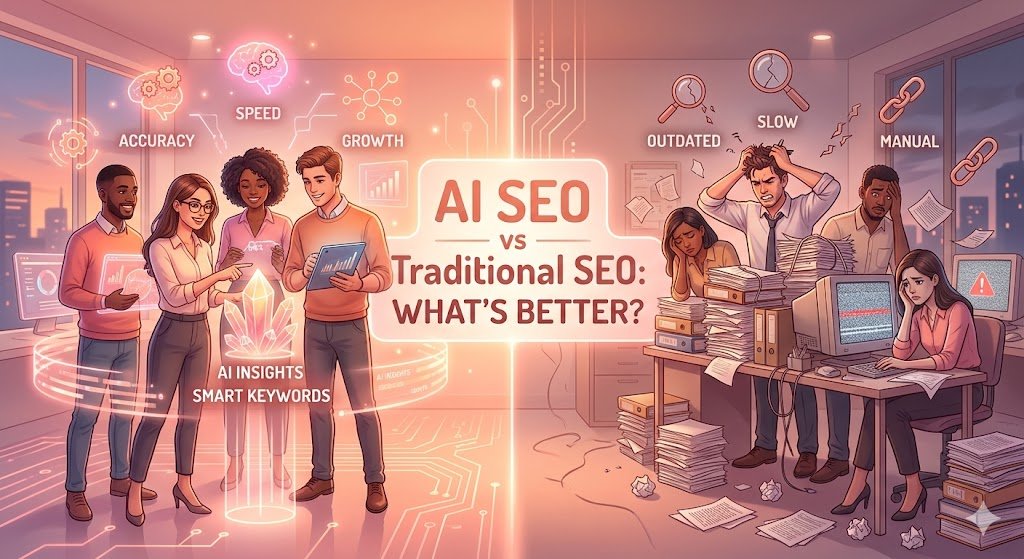
Every day, Google handles more than 8.5 billion queries – a number shaped heavily by machines now working behind the scenes. Though once just tools for finding pages, search systems are evolving fast because smart algorithms run them. Marketers aiming to appear in results also rely on these same technologies, quietly adjusting tactics without fanfare. Because of this shift, ignoring how automated thinking affects visibility means falling behind slowly. Staying ahead demands learning what drives today’s ranking logic, whether one likes it or not.
Picture this: AI reshaping every corner of SEO, step by step. Keyword hunting now shifts through smart patterns, not just volume counts. Creating articles feels less like typing, more like guiding a thinking tool. Technical checks happen faster, spotting hiccups before they grow. Backlinks get uncovered through behavior clues, not guesswork. Future trends emerge from data trails machines learn to follow. If you write alone from home, run a local shop, or handle big campaigns, none of it matters – this fits. It lines up what works, strips the noise, shows paths forward. Search success in 2026 leans on these moves, nothing else. The blueprint adapts, grows, stays clear when things shift again.
AI in SEO rankings explained simply?
Jumping straight into methods misses a key point first. What people mean by AI in SEO rankings becomes clear when machines learn patterns, understand human language, forecast outcomes, then act on them automatically. This mix helps websites show up more often where users look online. Each piece adjusts how well a page ranks across digital searches.
This encompasses two distinct but deeply interrelated dimensions:
1. AI within search engines themselves — Google’s own AI systems, including RankBrain, BERT, MUM, and the Gemini-powered Search Generative Experience (SGE), determine how content is evaluated and ranked. Understanding these systems is foundational to modern SEO.
2. AI-powered SEO tools used by marketers — Platforms like Semrush, Ahrefs, Surfer SEO, Clearscope, Jasper, and others use AI to help marketers research, create, optimize, and monitor content more effectively than any human could at scale.
Both dimensions are inseparable. To truly master AI for search engine optimization rankings, you need to understand what AI looks for in content, and use AI tools to deliver exactly that.
How Google’s AI Algorithms Rank Content
Google has moved far beyond simple keyword matching. Today, its ranking systems rely heavily on AI to understand the intent, quality, and context behind every search query and every piece of content. Here’s what’s powering modern Google rankings:
RankBrain: Understanding Intent
Launched in 2015, RankBrain was Google’s first major AI integration into its core ranking algorithm. It uses machine learning to interpret unfamiliar search queries — those Google has never seen before — by mapping them to conceptually similar queries it understands.
What this means for SEO: content must satisfy the intent behind a search, not just match the surface-level keywords. AI for search engine optimization rankings begins with understanding that Google reads meaning, not just words.
BERT: Natural Language Processing at Scale
BERT (Bidirectional Encoder Representations from Transformers) launched in 2019 and transformed how Google understands the nuance of language — particularly prepositions, pronouns, and conversational phrasing. BERT processes words in context, understanding that “bank” means something very different in “river bank” versus “bank account.”
For content creators, BERT’s existence reinforces a critical principle: write naturally for humans, not robotically for crawlers.
MUM: Multi-Modal Understanding
MUM (Multitask Unified Model) is 1,000 times more powerful than BERT and can simultaneously process text, images, and video across 75 languages. It’s Google’s attempt to understand complex, multi-part queries the way a knowledgeable human advisor would.
MUM raises the bar for what “comprehensive” content means. To compete in a MUM-powered search environment, AI for search engine optimization rankings requires producing content that covers topics in depth, from multiple angles, in multiple formats.
Google’s Search Generative Experience (SGE)
SGE — Google’s AI-generated answer summaries at the top of search results — represents perhaps the most disruptive shift in SEO since the mobile revolution. These AI-generated overviews synthesize answers from multiple sources, often reducing click-through rates for traditional blue-link results.
Adapting to SGE requires creating content that is authoritative, well-structured, factually accurate, and citable. Ironically, the way to win in an AI-answer world is to produce the best human-quality content — which itself increasingly requires AI for search engine optimization rankings tools to research and optimize.
The 10 Ways AI Is Transforming SEO Rankings
1. Smarter Keyword Research
Traditional keyword research involved manually reviewing search volume and competition data for individual terms. AI-powered keyword research tools have completely transformed this process.
Platforms like Semrush, Ahrefs, and Google’s own Keyword Planner now incorporate machine learning to:
- Identify semantic keyword clusters — groups of related terms that signal topical authority
- Surface long-tail keyword opportunities with low competition and high conversion intent
- Predict trending keywords before they peak in search volume
- Map keywords to user intent (informational, navigational, commercial, transactional)
- Analyze competitor keyword gaps at scale
The result is that AI for search engine optimization rankings allows SEOs to move from guessing which keywords to target to making data-driven decisions with genuine strategic confidence.
Actionable Tip: Use AI-powered tools to build topic clusters rather than targeting isolated keywords. A central “pillar page” supported by 10–15 related “cluster pages” signals comprehensive topical authority to Google’s algorithms.
2. AI-Powered Content Creation and Optimization
Content is still the cornerstone of SEO — but the volume, quality, and speed requirements have increased dramatically. This is where AI for search engine optimization rankings delivers perhaps its most visible impact.
AI writing and optimization tools like Jasper, Copy.ai, Surfer SEO, Clearscope, and MarketMuse help SEO teams:
- Generate content briefs based on top-ranking competitor pages
- Identify semantic entities and LSI keywords that Google expects to see in comprehensive content
- Score content in real-time against top-ranking competitors on your target keyword
- Produce first drafts that writers can refine rather than starting from scratch
- Optimize existing content that’s stagnating in rankings
It’s worth being clear: AI-generated content, used without human oversight, rarely ranks well. Google’s quality rater guidelines emphasize E-E-A-T (Experience, Expertise, Authoritativeness, Trustworthiness) — qualities that require human insight, real experience, and original perspective. The best approach is to use AI for search engine optimization rankings as a powerful first-draft and optimization assistant, with human experts adding the depth and authenticity that drives rankings.
3. Predictive SEO Analytics
One of the most exciting applications of AI for search engine optimization rankings is predictive analytics — using historical data and machine learning models to forecast future ranking opportunities, traffic trends, and algorithm impacts.
AI-powered predictive SEO can:
- Forecast which pages are likely to lose rankings without content refreshes
- Predict seasonal traffic spikes months in advance
- Identify keywords whose search volume is growing before they become competitive
- Model the projected traffic and revenue impact of ranking improvements
- Alert teams to potential algorithmic volatility before it hits
Tools like BrightEdge, Conductor, and seoClarity incorporate predictive AI engines that give SEO teams a genuine “future sight” advantage — moving from reactive firefighting to proactive strategy.
4. Technical SEO Auditing and Automation
Technical SEO — the infrastructure layer that enables search engines to crawl, index, and understand your website — has historically been labor-intensive and difficult to scale. AI for search engine optimization rankings has automated much of this complexity.
AI-powered technical SEO tools can automatically:
- Crawl millions of pages and identify critical errors (broken links, duplicate content, canonicalization issues, crawl depth problems)
- Prioritize fixes by estimated ranking impact rather than dumping raw data
- Detect Core Web Vitals issues — page speed, interactivity, and visual stability metrics that Google uses as ranking factors
- Identify JavaScript rendering problems that prevent Googlebot from indexing dynamic content
- Monitor structured data markup (Schema.org) and flag implementation errors
- Track log file patterns to identify how Googlebot is actually crawling your site
Without AI, a comprehensive technical audit of a large website could take weeks. With modern AI-powered crawlers, the same audit can be completed in hours — with prioritized action plans generated automatically.
5. AI-Driven Link Building Intelligence
Backlinks remain one of the most powerful ranking signals in Google’s algorithm. But not all links are created equal — and earning high-quality links requires strategic intelligence that AI for search engine optimization rankings now makes scalable.
AI link building tools help by:
- Identifying high-authority link prospects based on topical relevance, domain authority, and link-earning history
- Analyzing competitor backlink profiles to find link-building opportunities you’re missing
- Detecting toxic backlinks that could trigger Google penalties and should be disavowed
- Personalizing outreach emails using natural language generation to improve response rates
- Predicting link value by modeling how specific links are likely to impact rankings
Rather than manually researching thousands of potential link partners, AI handles the discovery and scoring, allowing SEO teams to focus their time on relationship-building and outreach — the human skills that can’t be automated.
6. User Experience Optimization
Google has made clear that user experience (UX) is a ranking factor. Pages that load fast, are visually stable, respond quickly to user input, and satisfy search intent rank better than those that don’t. AI for search engine optimization rankings now extends into UX optimization in powerful ways.
AI-powered UX tools help improve rankings by:
- Analyzing user behavior patterns — heatmaps, scroll depth, click patterns — to identify where users disengage
- Running multivariate A/B tests at scale to optimize page layouts for time-on-page and conversion
- Personalizing page content dynamically based on user segment and intent signals
- Optimizing Core Web Vitals through automated image compression, code splitting, and caching recommendations
- Improving internal linking structures by identifying where users naturally navigate and reinforcing those paths
Higher user engagement signals — lower bounce rates, longer dwell times, more pages per session — send positive quality signals to Google’s AI ranking systems, creating a virtuous cycle where good UX feeds better rankings.
7. Voice Search and Conversational Query Optimization
Voice search has fundamentally changed the nature of search queries. When people speak to Siri, Alexa, or Google Assistant, they use natural, conversational language — complete questions like “What’s the best way to lose weight fast?” rather than fragmented text queries like “best weight loss tips.”
AI for search engine optimization rankings enables marketers to optimize for this conversational query landscape by:
- Identifying question-based keyword patterns (who, what, when, where, why, how) that dominate voice search
- Structuring content with FAQ sections that directly answer these questions in natural language
- Optimizing for featured snippets — the position zero results that voice assistants frequently read aloud
- Creating content at the right reading level for the conversational, accessible tone voice queries expect
- Building structured data markup that helps search engines extract and present key information
As smart speakers proliferate and AI assistants become more sophisticated, voice search optimization will only grow in importance. Getting ahead of this trend with AI for search engine optimization rankings tools positions businesses favorably for the next evolution of search.
8. Local SEO Intelligence
For businesses that serve specific geographic areas, local SEO is the highest-leverage channel available. AI for search engine optimization rankings has introduced a new level of sophistication to local search strategies.
AI-powered local SEO tools help businesses:
- Monitor and respond to Google reviews at scale — with AI-generated response templates that maintain brand voice
- Analyze local competitor positioning across multiple locations simultaneously
- Optimize Google Business Profile attributes (hours, services, photos, Q&A) based on what’s driving rankings in a specific market
- Identify local citation gaps — directory listings where competitors appear but you don’t
- Track local SERP volatility — algorithm fluctuations that affect local pack rankings differently than organic results
For multi-location businesses especially, manual local SEO management is virtually impossible at scale. AI transforms what would require an army of local SEO managers into a streamlined, data-driven operation.
9. SERP Monitoring and Competitive Intelligence
Rankings don’t exist in a vacuum — they shift constantly based on algorithm updates, competitor actions, and changes in search behavior. Real-time SERP monitoring with AI is an essential component of AI for search engine optimization rankings strategy.
AI-powered monitoring tools continuously track:
- Ranking position changes across thousands of keywords, by device and location
- Competitor ranking movements — who’s gaining on your key terms and why
- SERP feature changes — when featured snippets, knowledge panels, or People Also Ask boxes appear for your keywords
- Algorithm update correlation — mapping ranking changes to Google’s confirmed and unconfirmed algorithm updates
- Share of voice — your brand’s overall search visibility relative to competitors across an entire keyword landscape
This intelligence allows SEO teams to respond to threats and opportunities in real time rather than discovering ranking drops weeks later through traffic analytics.
10. Content Freshness and Updating at Scale
Google consistently favors fresh, up-to-date content for many query types — particularly news, reviews, statistics, and how-to guides. One of the most underutilized applications of AI for search engine optimization rankings is the systematic identification and updating of stale content.
AI tools can:
- Audit existing content to identify pages where rankings are declining due to outdated information
- Flag specific data points, statistics, or claims within existing content that need refreshing
- Suggest structural improvements to existing pages based on how top-ranking competitors have evolved their content
- Generate updated sections that can be inserted into existing articles to boost freshness signals
- Prioritize update candidates by estimated traffic recovery potential
A well-executed content refresh program powered by AI for search engine optimization rankings tools can recover significant amounts of lost organic traffic without the cost and time required to create entirely new content.
Building an AI-Powered SEO Tech Stack
Implementing AI for search engine optimization rankings effectively requires assembling the right collection of tools. Here’s a recommended stack by function:
| Function | Top AI-Powered Tools | Starting Price |
|---|---|---|
| Keyword Research | Semrush, Ahrefs, Keyword Insights | $99–$129/month |
| Content Optimization | Surfer SEO, Clearscope, MarketMuse | $49–$149/month |
| Content Creation | Jasper, Copy.ai, Claude | $39–$99/month |
| Technical SEO | Screaming Frog + AI, Sitebulb, DeepCrawl | $25–$300/month |
| Rank Tracking | Semrush, AccuRanker, STAT | $99–$199/month |
| Link Building | Ahrefs, Majestic, Pitchbox | $99–$195/month |
| Local SEO | BrightLocal, Whitespark | $39–$79/month |
| Analytics & Prediction | Google Analytics 4, BrightEdge, Conductor | Free–$500+/month |
| Site Speed / CWV | PageSpeed Insights, GTmetrix, NitroPack | Free–$69/month |
You don’t need every tool in this list. The most effective approach for most businesses is to start with a comprehensive all-in-one platform (Semrush or Ahrefs), add a dedicated content optimization tool (Surfer SEO or Clearscope), and layer in specialized tools as needs grow.
The Human Element: Why AI Doesn’t Replace SEO Expertise
A critical nuance in the conversation about AI for search engine optimization rankings: AI amplifies human expertise — it doesn’t replace it.
Google’s E-E-A-T framework (Experience, Expertise, Authoritativeness, Trustworthiness) places enormous weight on signals that only humans can authentically provide:
- Real-world experience with the topics being written about
- Original research, data, and insights not available elsewhere
- Author credentials and reputation within an industry
- Editorial judgment about what information is genuinely useful versus filler
- Brand voice and personality that creates loyal, returning audiences
The most successful SEO practitioners in 2026 are those who use AI for search engine optimization rankings to handle the high-volume, data-intensive tasks — research, audit, optimization scoring, monitoring — while directing their own human expertise toward strategy, original thinking, and quality editorial control.
AI handles the scale. Humans provide the substance.
AI, Ethics, and Google’s Content Policies
One of the most common questions about AI for search engine optimization rankings concerns Google’s stance on AI-generated content. The answer, as of 2026, is nuanced.
Google has explicitly stated that it does not penalize AI-generated content as a category. What Google penalizes is content that is:
- Low quality and thin — regardless of whether it was written by a human or AI
- Deceptive — designed to manipulate rankings rather than genuinely help users
- Mass-produced — scaled content farms that flood the web with near-identical articles
- Lacking original value — content that aggregates existing information without adding new insight
The practical implication: AI-generated or AI-assisted content that is high quality, accurate, original, and genuinely useful to readers is treated exactly the same as human-written content. The bar isn’t who wrote it — it’s whether it serves the reader.
Used responsibly, AI for search engine optimization rankings is fully aligned with Google’s guidelines. Used to game the system with low-effort content at scale, it will ultimately backfire.
Measuring the Impact of AI on Your SEO Rankings
Implementing AI tools without measuring their impact is like investing in expensive gym equipment and never checking whether you’re getting fitter. Here are the key metrics to track when deploying AI for search engine optimization rankings:
Organic Traffic
Monitor overall organic sessions in Google Analytics 4, segmented by landing page, device, and geographic market. Set baseline measurements before AI tools are implemented so you can attribute changes accurately.
Keyword Rankings
Track position changes for your priority keyword clusters in a dedicated rank tracking tool. Look not just at average position but at the distribution of keywords ranking in positions 1–3, 4–10, 11–20, and below.
Organic Click-Through Rate (CTR)
Google Search Console provides CTR data by query and page. AI-optimized meta titles and descriptions should improve CTR, bringing more traffic without requiring ranking improvements.
Core Web Vitals Scores
Technical AI tools should improve your Largest Contentful Paint (LCP), Interaction to Next Paint (INP), and Cumulative Layout Shift (CLS) scores. Monitor these in Google Search Console’s Core Web Vitals report.
Content Efficiency
Track how AI-assisted content production affects cost-per-published-word, time-to-publish, and the average ranking performance of new content compared to pre-AI benchmarks.
Backlink Growth
Monitor domain rating, total referring domains, and new links earned per month. AI-powered link prospecting and outreach should produce a measurable improvement in link acquisition rates.
Conversion Rate from Organic Traffic
Ultimately, rankings and traffic only matter if they drive business outcomes. Track leads, sign-ups, and sales attributable to organic search using proper attribution modeling in GA4.
Common Mistakes When Using AI for SEO
Even with the best AI for search engine optimization rankings tools at hand, there are several critical mistakes that undermine results:
Over-Relying on AI-Generated Content
AI produces plausible-sounding text at scale — but plausible is not the same as accurate, insightful, or original. Publishing AI content without human review is a recipe for factual errors, generic perspectives, and eventual ranking penalties.
Ignoring Search Intent
AI keyword tools can surface thousands of keyword opportunities. But without understanding the intent behind those queries, you’ll create content that attracts the wrong visitors or fails to convert the right ones. Always layer human judgment over AI data.
Treating Technical SEO as a One-Time Fix
AI technical audit tools can identify hundreds of issues in a single crawl. Prioritize ruthlessly — fix high-impact, high-effort issues first — and schedule regular re-audits, because websites are dynamic systems that constantly generate new technical debt.
Neglecting Off-Page Signals
No amount of AI-optimized on-page content can compensate for a weak backlink profile. Link building remains the most difficult and most valuable part of SEO — and while AI for search engine optimization rankings can improve the efficiency of link prospecting and outreach, the relationship-building at its core is irreducibly human.
Chasing Algorithms Instead of Users
The ultimate north star of SEO — with or without AI — is serving users better than anyone else. Businesses that use AI for search engine optimization rankings to genuinely understand what their customers are looking for and create content that satisfies those needs will outperform those gaming metrics every time.
The Future of AI and Search Rankings
The trajectory is clear: AI will continue to deepen its role in both search engines and SEO strategy. Here’s what to watch:
Generative Search Experiences Expanding
Google’s AI-generated overviews will cover more query types and dominate more SERP real estate. SEO strategies will increasingly focus on being cited within AI answers, not just ranking in traditional blue-link results.
Multimodal Content Becoming Standard
With MUM and future models processing text, images, video, and audio simultaneously, SEO will extend beyond written content into comprehensive multimedia experiences. AI tools for video SEO and image optimization will become essential.
Real-Time Personalization in Rankings
AI is enabling increasingly personalized search results — different users seeing different rankings for the same query based on their search history, location, device, and behavior patterns. AI for search engine optimization rankings will need to account for this personalization layer.
Autonomous SEO Agents
The next frontier is AI agents that monitor rankings, identify opportunities, and implement optimizations autonomously — with minimal human intervention required. Early versions already exist; full autonomy is years away but clearly on the horizon.
Zero-Click Search Dominance
As AI answers more questions directly in the SERP, the importance of brand-building, thought leadership, and direct traffic will grow. SEOs who rely exclusively on click-through traffic will need to diversify into brand awareness strategies that complement their technical ranking work.
Conclusion: Embrace AI or Fall Behind
The integration of artificial intelligence into search is not a trend — it’s a fundamental restructuring of how content is discovered, evaluated, and consumed online. Businesses and marketers who embrace AI for search engine optimization rankings today are building a compound advantage that will be increasingly difficult for late adopters to overcome.
The key takeaways from this guide:
- Google’s own AI — RankBrain, BERT, MUM, and SGE — rewards content that genuinely satisfies user intent at the highest quality level
- AI for search engine optimization rankings tools dramatically accelerate keyword research, content optimization, technical audits, link building, and performance monitoring
- AI amplifies human expertise rather than replacing it — the combination of machine efficiency and human judgment produces the best results
- Ethical, quality-first use of AI content tools is fully aligned with Google’s content policies
- Measurement is essential — track organic traffic, rankings, CTR, Core Web Vitals, and conversions to quantify AI’s impact on your SEO program
The question is no longer whether to use AI for search engine optimization rankings. The question is how quickly you can build the knowledge, tools, and processes to leverage it before your competitors do.
Start today. The search landscape is not waiting.
Frequently Asked Questions
Q: Does Google penalize AI-generated content? Google does not penalize AI-generated content as a category. It penalizes low-quality, thin, or deceptive content — regardless of whether it was produced by a human or an AI. High-quality AI-assisted content is treated the same as high-quality human-written content.
Q: What is the best AI tool for SEO rankings? There’s no single best tool — the optimal stack depends on your needs and budget. Semrush and Ahrefs are the most comprehensive all-in-one platforms. Surfer SEO and Clearscope lead in content optimization. Jasper and Claude are powerful content creation assistants.
Q: How long does it take to see results from AI-powered SEO? The same timeline applies as traditional SEO — typically 4–6 months for meaningful organic traffic improvements. AI accelerates the research, optimization, and auditing process, but Google’s ranking algorithms still take time to recognize and reward quality improvements.
Q: Can small businesses use AI for SEO? Absolutely. Many AI SEO tools offer affordable entry-level plans, and free tools like Google Search Console and Google Analytics 4 provide powerful AI-driven insights at no cost. Small businesses that adopt AI for search engine optimization rankings early gain a significant competitive advantage over those relying on traditional manual methods.
Q: Is AI going to replace SEO professionals? No — AI is changing what SEO professionals do, not whether they’re needed. The demand for SEO expertise is growing as the discipline becomes more technical and strategically complex. AI handles execution at scale; humans direct strategy, ensure quality, and build the relationships that drive sustainable results.
This article is for informational purposes only. Specific tool features, pricing, and Google algorithm details are accurate as of June 2026 and subject to change.