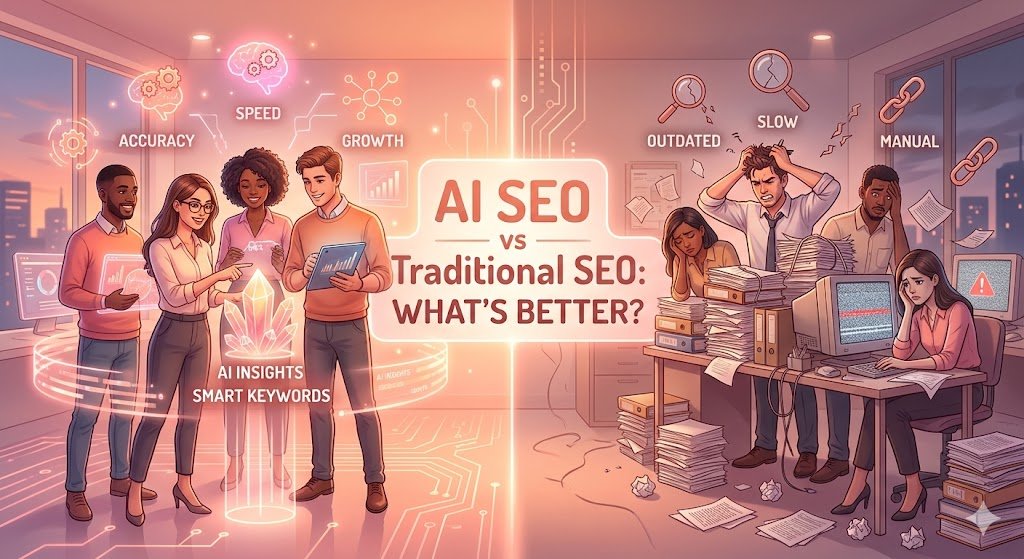
Some corners of online marketing still argue fiercely about AI-driven SEO versus the classic kind. Not long ago, success meant digging through keywords by hand, writing every word yourself, slowly earning backlinks, fixing site issues step by step. Lately, smart software claims to handle those same tasks in moments instead of months.
Truth be told, it’s not so simple to pick a winner. Most folks think one option clearly wins, yet reality doesn’t agree – especially when rankings matter and traffic ties directly to income. Knowing the subtle differences can mean serious returns for anyone running an online site.
Picture this. A full look at AI SEO next to old-school SEO, point by point – how fast it works, how good the output is, what it costs, whether it can grow, if it lasts, and what comes out of it. Stick around long enough and you will see a way to choose – not only what fits now, but also how to shift gears when search shifts too.
From here, things begin. The first step shows up when you look back at where it started.
Defining the Terms: What Is AI SEO vs Traditional SEO?
Before comparing the two, it’s important to establish clear definitions. The AI SEO vs Traditional SEO debate often suffers from imprecise language, with people talking past each other because they’re not comparing the same things.
Traditional SEO refers to the established, human-driven practices that have defined search engine optimization since the early 2000s. It includes manual keyword research using tools like Google Keyword Planner, human-written content developed from personal expertise, link-building through manual outreach and relationship development, technical audits conducted by SEO specialists, and performance analysis reviewed by strategists in monthly reports. Traditional SEO is methodical, expertise-driven, and inherently limited by the time and cognitive bandwidth of the humans executing it.
AI SEO refers to the use of artificial intelligence — machine learning algorithms, natural language processing, predictive analytics, and automation — to perform, enhance, or scale traditional SEO tasks. AI SEO tools analyze vast datasets at superhuman speed, identify patterns invisible to human analysts, generate content at scale, automate technical monitoring, and predict future ranking opportunities before they become obvious in the data.
It’s worth noting immediately that the AI SEO vs Traditional SEO framing, while useful for analysis, is somewhat artificial in practice. Most sophisticated SEO programs today are hybrid operations — using AI tools to augment human expertise rather than replace it entirely. But examining the two approaches in isolation reveals important truths about where each excels, where each falls short, and how they’re best combined.
The Core Differences: AI SEO vs Traditional SEO Side by Side
Speed and Efficiency
This is the most obvious and dramatic difference in the AI SEO vs Traditional SEO comparison.
Traditional SEO is slow — not because practitioners are inefficient, but because many of its core tasks are genuinely time-intensive. Manually researching keywords for a new content campaign might take a skilled SEO analyst two to three days. Writing a comprehensive, well-researched blog post takes four to eight hours. Auditing a website with thousands of pages for technical issues could take weeks. Analyzing a competitor’s full backlink profile manually? Practically impossible at any meaningful scale.
AI SEO collapses these timelines dramatically. An AI-powered keyword research tool can surface thousands of opportunities, grouped by semantic cluster and intent, in under an hour. An AI content optimization tool can analyze the top 20 ranking pages for any keyword and generate a detailed content brief in minutes. AI crawlers can audit a 50,000-page website overnight and produce a prioritized action plan by morning.
In the AI SEO vs Traditional SEO speed comparison, AI wins — and it’s not particularly close. The question is whether speed translates to better outcomes, which requires examining quality and effectiveness.
Content Quality and Originality
Here’s where the AI SEO vs Traditional SEO debate gets genuinely complex — and where many AI SEO advocates overclaim.
Traditional SEO produces content rooted in real human expertise, original research, personal experience, and editorial judgment. A seasoned financial advisor writing about retirement planning draws on decades of professional experience, client interactions, and nuanced understanding of edge cases that no AI model has directly encountered. This authenticity and depth is exactly what Google’s E-E-A-T framework (Experience, Expertise, Authoritativeness, Trustworthiness) is designed to reward.
AI SEO, when used for content generation without appropriate human oversight, produces content that is fluent and plausible but often shallow, generic, and lacking the original insight that makes content truly valuable. AI models synthesize from existing web content — they cannot draw on proprietary research, unique professional experience, or the kind of counterintuitive insights that come from deep domain expertise.
However, the AI SEO vs Traditional SEO content comparison changes significantly when AI is used as a collaborative tool rather than a replacement. AI-assisted content — where AI handles structural research, semantic optimization, and first-draft generation while human experts add original insight, factual verification, and editorial polish — consistently outperforms both pure AI content and unoptimized human content in ranking performance.
The verdict: for content quality, traditional human expertise wins on depth and originality. AI wins on scale and optimization. The combination wins on results.
Keyword Research and Strategic Depth
Traditional SEO keyword research is constrained by human capacity. An analyst can realistically evaluate hundreds of keyword opportunities in a detailed research session. They bring strategic intuition, business context, and competitive awareness to the process — but they’re limited in how much data they can process and how many patterns they can identify simultaneously.
AI SEO keyword research operates at a fundamentally different scale. Modern AI-powered platforms analyze billions of search queries, identify thousands of semantic keyword clusters, map search intent across entire topic ecosystems, and surface long-tail opportunities that human analysts would simply never discover manually. They can simultaneously analyze competitor keyword gaps across dozens of domains and predict which emerging keywords are gaining momentum before competition intensifies.
In the AI SEO vs Traditional SEO keyword research comparison, AI offers a genuine capability advantage — not just a speed advantage. The strategic depth enabled by AI-powered keyword intelligence simply cannot be replicated manually.
That said, AI keyword tools still benefit enormously from human strategic judgment. Raw data volume is not a strategy. A skilled SEO strategist using AI tools to surface opportunities and then applying business context, audience knowledge, and competitive understanding to prioritize them will consistently outperform either pure AI or pure human research.
Technical SEO: Automation vs. Expertise
Technical SEO — the infrastructure layer that enables search engines to crawl, index, and correctly interpret websites — is perhaps the domain where AI SEO vs Traditional SEO differences are most consequential at scale.
Traditional technical SEO relies on specialist expertise to identify and resolve issues: crawlability problems, duplicate content, canonicalization errors, JavaScript rendering failures, Core Web Vitals deficiencies, structured data implementation errors, and site architecture problems. An experienced technical SEO professional brings deep knowledge of how search engine crawlers work and how to prioritize fixes for maximum impact.
The limitation is scale. A single technical SEO specialist can realistically manage detailed audits of a handful of websites. Monitoring thousands of pages continuously for emerging issues? Impossible manually.
AI SEO transforms technical SEO through automation and scale. AI-powered crawlers monitor websites continuously, alert teams to new issues immediately, prioritize fixes by projected ranking impact, and in some cases implement automated fixes without human intervention. They detect Core Web Vitals regressions in real time, identify when new content creates canonicalization conflicts, and flag structured data errors as they appear.
In the AI SEO vs Traditional SEO technical comparison, AI wins decisively on scale and continuous monitoring. Human expertise wins on nuanced problem-solving for complex, non-standard technical issues. The ideal approach combines AI for continuous monitoring and initial diagnosis with human expertise for strategic prioritization and complex remediation.
Link Building: The Hardest Problem in SEO
Backlinks remain one of Google’s most powerful ranking signals — and link building remains the most stubbornly human aspect of SEO. This is where the AI SEO vs Traditional SEO comparison reveals the clearest limits of pure AI approaches.
Traditional link building relies on genuine relationship development: researching relevant websites, crafting personalized outreach, building editor relationships over time, creating content specifically designed to earn links, and developing a reputation in your industry that makes other site owners want to reference your work. These are fundamentally human activities that depend on authenticity, judgment, and relationship skills.
AI SEO contributes meaningfully to link building efficiency without being able to replace its human core. AI tools excel at identifying high-authority link prospects from vast databases of domains, analyzing competitor backlink profiles to find acquisition opportunities, detecting toxic links that risk penalties, personalizing outreach emails at scale using natural language generation, and predicting the ranking value of specific links before resources are invested in pursuing them.
But AI cannot build authentic relationships, generate the original research and insights that naturally attract links, or exercise the editorial judgment required to identify which link opportunities are genuinely valuable versus superficially appealing. In the AI SEO vs Traditional SEO link building comparison, AI enhances efficiency while human relationship skills drive effectiveness.
Analytics, Reporting, and Adaptability
Traditional SEO analytics has always been a backward-looking discipline. Monthly reports show what happened: which rankings changed, how traffic moved, which pages gained or lost visibility. Skilled analysts can draw insights from this data and adjust strategy — but the inherent lag means responses to threats and opportunities are often delayed by weeks.
AI SEO introduces predictive and real-time dimensions that fundamentally change this dynamic. AI-powered analytics platforms monitor ranking movements continuously, alerting teams to significant changes within hours rather than at the next monthly report. Predictive models identify content that is likely to lose rankings before traffic actually drops, enabling proactive intervention. Machine learning algorithms identify statistical patterns in ranking data that human analysts would take days to detect manually.
The AI SEO vs Traditional SEO analytics comparison reveals perhaps the clearest competitive advantage of AI: moving from reactive to proactive strategy. Businesses using AI-powered SEO analytics consistently respond to algorithm changes faster, capitalize on emerging keyword opportunities earlier, and sustain ranking performance more consistently than those relying on traditional monthly reporting cycles.
Cost: Investment vs. Return
Cost comparison is where the AI SEO vs Traditional SEO debate gets particularly practical for business decision-makers.
Traditional SEO is primarily a human labor cost. Experienced SEO professionals command salaries of $60,000–$120,000 annually in-house, or agency retainers of $2,000–$10,000+ per month for comprehensive managed services. The output is limited by the hours available — a traditional SEO team’s capacity plateaus with headcount.
AI SEO tools represent a technology cost: platform subscriptions ranging from $100/month for basic tools to $500–$2,000+/month for enterprise-grade platforms. The output does not plateau with team size — a small team equipped with AI tools can execute the strategic scope previously requiring a team three times larger.
However, the cost comparison in AI SEO vs Traditional SEO is deceptive if viewed only as a line item. The more meaningful measure is cost-per-result: what does it cost to produce a page-one ranking, a qualified organic lead, or a dollar of revenue from organic search?
By this measure, AI SEO typically delivers superior economics at scale. A mid-sized business that previously needed a five-person SEO team to manage its content program can achieve comparable or superior output with two SEO strategists and a well-configured AI tool stack. The savings, reinvested in strategy and high-quality human-generated content, compound into a significant competitive advantage.
Scalability and Long-Term Sustainability
Scalability may be the most decisive dimension in the AI SEO vs Traditional SEO comparison for growing businesses.
Traditional SEO scales linearly with human resources. To double your content output, you roughly need to double your writing team. To monitor twice as many keyword rankings, you need proportionally more analyst time. Growth in SEO scope means proportional growth in headcount and cost.
AI SEO scales non-linearly. A well-configured AI tool stack can process ten times more keyword data, monitor ten times more pages, and analyze ten times more competitor signals without a proportional increase in cost or headcount. As your website grows from 100 pages to 10,000, AI monitoring, optimization, and analysis tools scale with it effortlessly.
For long-term sustainability, however, the AI SEO vs Traditional SEO comparison introduces an important caveat. Pure AI SEO — content farms generating AI-written articles at massive scale without genuine editorial value — is not sustainable. Google’s quality systems are specifically designed to identify and demote exactly this pattern. Businesses that use AI to scale quantity at the expense of quality are building on sand.
Sustainable, scalable SEO in 2026 means using AI to scale the efficiency of high-quality, expert-driven content and strategy — not to substitute quantity for quality.
Where Traditional SEO Still Has the Edge
In a comprehensive AI SEO vs Traditional SEO analysis, intellectual honesty requires acknowledging where traditional, human-driven approaches maintain genuine advantages.
Strategic Creativity The most impactful SEO strategies — identifying untapped content angles, developing unique research that earns media coverage, finding innovative link-building approaches in a specific industry — emerge from creative human thinking that AI cannot replicate. AI optimizes within established patterns; humans discover new ones.
Brand Voice and Authentic Storytelling A brand’s distinctive voice, personality, and storytelling approach cannot be authentically reproduced at scale by AI. Readers and Google’s quality systems both detect when content lacks genuine human authorship. Authentic brand voice is a competitive differentiator that requires human creative direction.
Relationship-Based Authority Building The highest-quality backlinks, guest posting opportunities, podcast appearances, and industry partnerships are earned through human relationships. No AI tool can shake hands, attend a conference, or build the kind of professional trust that generates the most valuable editorial links.
Nuanced Competitive Strategy Understanding why a competitor is winning in search — and developing a creative response that goes beyond matching their content — requires the kind of competitive intuition and strategic creativity that remains distinctly human.
Novel Problem Solving When a website experiences a mysterious traffic drop that doesn’t match any obvious technical or content issue, the kind of investigative reasoning required to diagnose the problem and develop a creative solution still relies on experienced human judgment.
Where AI SEO Has the Decisive Edge
Equally, a fair AI SEO vs Traditional SEO comparison acknowledges where AI capabilities are now definitively superior:
Data Processing at Scale Analyzing millions of keywords, thousands of competitor pages, or years of ranking data simultaneously is simply beyond human cognitive capacity. AI processes these datasets in minutes and surfaces insights that would be invisible to manual analysis.
Continuous Monitoring Websites change constantly, and so do SERPs. AI monitoring tools watch for ranking changes, new competitor content, technical issues, and algorithm signals around the clock — something no human team can match.
Semantic Content Optimization AI-powered content optimization tools identify the precise semantic entities, related concepts, and structural elements that top-ranking competitors include — providing a scientifically grounded blueprint for content that Google’s AI systems recognize as comprehensive and authoritative.
Predictive Intelligence Forecasting which pages are at risk of ranking declines, which keywords are gaining momentum, and which technical issues are becoming ranking factors requires pattern recognition across datasets too large for human analysis. AI predictive tools give SEO teams a genuine strategic advantage over those operating purely reactively.
Technical Automation Continuous crawling, automated issue detection, Core Web Vitals monitoring, and structured data validation at scale are tasks where AI doesn’t just outperform humans — it handles tasks that are literally impossible to execute manually on large websites.
The Winning Formula: Integration, Not Competition
The most important insight in the AI SEO vs Traditional SEO debate is that framing it as a competition is itself the wrong mental model. The businesses achieving the strongest SEO results in 2026 are not those who chose AI over traditional methods or traditional methods over AI — they’re the ones who integrated both into a coherent, complementary strategy.
Here’s what that integration looks like in practice:
Research Phase: AI tools surface keyword opportunities, competitive gaps, and content angles at scale. Human strategists apply business context, audience knowledge, and creative judgment to prioritize and refine.
Content Creation: AI generates research briefs, semantic optimization guides, and structural frameworks. Human writers and subject matter experts contribute original insight, personal experience, and brand voice. AI tools score and optimize the final content before publication.
Technical SEO: AI tools handle continuous monitoring, automated issue detection, and prioritization. Human technical SEO specialists manage complex problem-solving, strategic architecture decisions, and nuanced remediation.
Link Building: AI tools identify prospects, analyze opportunity value, and support outreach personalization at scale. Human relationship managers develop authentic connections, craft compelling pitches, and build the industry reputation that generates the highest-value links.
Analytics and Strategy: AI tools provide real-time monitoring, predictive alerts, and pattern recognition across large datasets. Human strategists interpret findings, make judgment calls about priorities, and develop creative strategic responses.
This is the answer to the AI SEO vs Traditional SEO question that actually matters in practice: not “which is better?” but “how do we combine them to maximize results?”
Practical Guidance: Choosing Your Approach
How should you weight AI SEO vs Traditional SEO in your own program? Here’s a practical framework based on your situation:
If you’re a solopreneur or very small business: Lean heavily on AI tools to multiply your personal capacity. AI keyword research, content optimization, and rank tracking tools allow one person to execute an SEO program that previously required a team. Invest the time saved in developing genuine expertise and original content that AI can’t replicate.
If you’re a growing SMB with a small marketing team: Build a hybrid stack where AI handles research, optimization, and monitoring while human team members focus on content quality, link building relationships, and strategic decisions. Budget allocation: approximately 30–40% technology tools, 60–70% human expertise and content production.
If you’re an established business with significant organic traffic: Invest in enterprise-grade AI SEO platforms for predictive analytics, continuous monitoring, and technical automation. Maintain a strong human strategy and content team focused on quality, creativity, and competitive differentiation. The AI SEO vs Traditional SEO balance at this scale is roughly equal investment in technology and talent.
If you’re an e-commerce site with thousands of product pages: AI is non-negotiable at this scale. Manual management of SEO across thousands of pages is simply not viable. AI-powered content optimization, technical monitoring, and programmatic page optimization are essential. Human effort concentrates on strategic category-level decisions and high-value editorial content.
If you’re a content publisher or media company: Content quality and editorial authority are your core competitive advantages. Use AI tools to accelerate research and optimize existing content, but invest heavily in human writers, editors, and journalists whose expertise and original reporting distinguish your content from AI-generated alternatives.
The Future of AI SEO vs Traditional SEO
The AI SEO vs Traditional SEO landscape will continue evolving rapidly. Understanding where each approach is headed helps future-proof your strategy:
AI capabilities will keep expanding. The gap between what AI tools can and cannot do is closing faster than most practitioners expect. Tasks currently requiring human expertise — nuanced competitive analysis, sophisticated content strategy, complex technical problem-solving — will increasingly be supported or partially automated by AI in the coming years.
Google’s AI will keep raising quality standards. As Google’s own AI systems become more sophisticated at detecting thin, generic, and artificially optimized content, the value of genuine human expertise, original research, and authentic brand voice will only increase. The floor of acceptable content quality is rising continuously.
The human premium will shift, not disappear. In the AI SEO vs Traditional SEO evolution, human expertise doesn’t become less valuable — its nature changes. The premium shifts from execution skills (writing content, running audits, researching keywords manually) to strategy skills (creative direction, relationship development, competitive insight, editorial judgment). Humans will do less of the former and more of the latter.
Agentic AI will automate more of the execution layer. Autonomous AI agents that identify opportunities, implement optimizations, draft content, and report on results with minimal human oversight are already emerging in enterprise platforms. Over the next several years, the AI side of AI SEO vs Traditional SEO will become increasingly agentic and self-directed.
The winners will be agnostic about the tools. The businesses that thrive in search over the next decade will not be defined by whether they use AI or traditional methods — they’ll be defined by their commitment to genuinely serving their audiences better than competitors do. The tools evolve; the principle is permanent.
Conclusion: The Question Has a Clear Answer — and a Complicated One
If the question is “which produces better raw outputs at scale — AI SEO or Traditional SEO?” the answer is AI, and the margin is substantial and growing.
If the question is “which produces better strategic outcomes over the long term — pure AI SEO or human-led traditional SEO?” the answer is human-led, because strategic creativity, authentic authority, and genuine relationship-building cannot be automated.
But the right question — the one that actually drives business results — is not AI SEO vs Traditional SEO at all. It’s: “How do I combine the scale and intelligence of AI tools with the creativity, judgment, and authentic expertise of skilled humans to build a search presence that outperforms competitors on both dimensions?”
That combination — not the choice between the two — is what SEO success looks like in 2026.
Frequently Asked Questions
Q: Is AI SEO better than traditional SEO? Neither is categorically better. AI SEO excels at scale, speed, data processing, and continuous monitoring. Traditional SEO excels at strategic creativity, authentic content, relationship-based link building, and nuanced competitive judgment. The most effective programs combine both.
Q: Will AI replace traditional SEO jobs? AI will reshape SEO roles rather than eliminate them. Execution-heavy tasks will be increasingly automated, shifting the human premium toward strategy, creative direction, relationship development, and editorial judgment. Demand for skilled SEO strategists who can direct AI tools effectively is growing, not shrinking.
Q: Does Google treat AI SEO content differently from human-written content? Google evaluates content quality and user value, not the production method. High-quality, accurate, and genuinely useful AI-assisted content is treated the same as equivalent human-written content. Low-quality, thin, or manipulative content is penalized regardless of how it was produced.
Q: How much should I invest in AI SEO tools vs. human SEO expertise? This depends on your scale and goals. A reasonable starting framework: early-stage businesses should invest 70% in human expertise and 30% in AI tools. At enterprise scale, the balance approaches 50/50 as AI automation takes over more of the execution layer.
Q: Is traditional SEO becoming obsolete? The principles of traditional SEO — quality content, authoritative backlinks, excellent user experience, technical health — are more relevant than ever. What’s changing is how those principles are executed. AI accelerates and enhances traditional SEO execution; it doesn’t make the underlying principles obsolete.
This article is for informational purposes only. Tool features, pricing, and search engine algorithm details are accurate as of June 2026 and subject to change.