
Search engine optimization has always evolved — but nothing has accelerated its transformation quite like artificial intelligence. From the way Google evaluates content to the tools marketers use to build strategies, AI in modern SEO has fundamentally rewritten the rulebook. What worked five years ago — stuffing keywords, buying bulk backlinks, spinning thin content — not only fails today but actively destroys rankings.
The businesses and marketers winning in search right now are those who understand and embrace AI in modern SEO as both the environment they operate in and the toolkit they rely on. This comprehensive guide covers every dimension of that relationship: how AI shapes search algorithms, how AI-powered tools are transforming SEO workflows, and how you can build a future-ready SEO strategy that thrives in an AI-driven digital world.
Whether you’re new to SEO or a seasoned practitioner looking to modernize your approach, this is your definitive resource on AI in modern SEO strategies.
What Does AI in Modern SEO Actually Mean?
Before exploring tactics and tools, it’s essential to understand what we mean when we talk about AI in modern SEO. The term encompasses two distinct but deeply connected realities:
First, AI is the engine inside search platforms themselves. Google, Bing, and other search engines now use sophisticated machine learning models to evaluate websites, interpret queries, understand language, and decide which content deserves to rank. Every time someone searches, AI is making hundreds of micro-decisions about relevance, quality, authority, and user intent.
Second, AI is the toolkit that SEO professionals use to research, create, optimize, and monitor content at a scale and speed that would be impossible manually. Tools powered by natural language processing, machine learning, and predictive analytics have transformed every stage of the SEO workflow.
Understanding both dimensions is what separates modern SEO practitioners from those still operating on outdated assumptions. AI in modern SEO is not a trend to observe from a distance — it’s the current operating environment of search itself.
How Google’s AI Systems Shape Modern Rankings
To truly master AI in modern SEO, you need to understand the AI systems that power Google’s ranking engine. Google doesn’t simply match keywords to web pages anymore. It reads intent, evaluates quality, and rewards genuine expertise. Here’s the AI infrastructure behind those decisions:
RankBrain: The Pioneer of Intent-Based Ranking
Introduced in 2015, RankBrain was Google’s first major deployment of machine learning in its core algorithm. Its primary job is to interpret unfamiliar or ambiguous search queries — ones Google hasn’t seen before — by mapping them to conceptually related queries it already understands.
The practical implication for AI in modern SEO: content must satisfy the underlying intent of a search, not just match its surface-level words. A page targeting “how to fix leaky faucet” needs to genuinely solve that problem, not just mention the phrase repeatedly.
BERT: Reading Language the Way Humans Do
BERT (Bidirectional Encoder Representations from Transformers), launched in 2019, transformed Google’s ability to understand the nuance and context of natural language. Rather than reading words in sequence, BERT processes entire sentences simultaneously — understanding how every word relates to every other word in context.
This means AI in modern SEO demands writing that sounds natural and human, not keyword-dense and robotic. BERT penalizes awkward, over-optimized copy and rewards flowing, contextually rich prose.
MUM: The Multimodal Understanding Revolution
MUM (Multitask Unified Model) is 1,000 times more powerful than BERT. It processes not just text but images, video, and audio — simultaneously, across 75 languages. MUM can understand complex, multi-part queries the way an expert human advisor would, drawing on a vast web of knowledge to deliver nuanced answers.
For SEO strategy, MUM raises the standard for what “comprehensive” content means. AI in modern SEO requires going beyond surface-level coverage to produce content that explores topics from multiple angles, formats, and perspectives.
Google’s Search Generative Experience (SGE)
SGE represents the most visible manifestation of AI in modern SEO for most users. These AI-generated overviews appear at the top of search results for a growing range of queries, synthesizing answers from multiple sources before users even see traditional blue-link results.
The strategic implication is significant: SEO success increasingly means being cited within AI-generated answers, not just ranking in organic positions. Content that is authoritative, well-structured, factually accurate, and specifically answers real questions is most likely to be incorporated into SGE responses.
The 9 Core Applications of AI in Modern SEO Strategy
1. Intelligent Keyword Research
Keyword research was once a manual, time-consuming process of checking search volumes one term at a time. AI in modern SEO has completely reinvented this discipline.
Modern AI-powered keyword tools — Semrush, Ahrefs, Keyword Insights, and others — analyze billions of search queries to surface:
- Semantic keyword clusters that signal topical authority to Google
- Long-tail opportunities with high purchase intent and lower competition
- Trending queries gaining momentum before they become competitive
- Intent classifications that separate informational, commercial, and transactional searches
- Competitor keyword gaps — terms your rivals rank for that you’re missing entirely
The result is a strategic clarity that simply wasn’t possible with manual keyword research. Rather than targeting isolated keywords, AI in modern SEO allows you to build comprehensive topic ecosystems that dominate entire subject areas in search results.
Strategic approach: Use AI tools to identify a central pillar topic and 10–20 related cluster topics. The pillar page covers the broad topic comprehensively; cluster pages dive deep into specific subtopics. This architecture signals subject-matter authority to Google’s AI ranking systems.
2. Content Creation and Semantic Optimization
Content remains the foundational currency of SEO — but AI in modern SEO has transformed both how content is produced and what “optimized” content looks like.
AI writing and optimization tools like Surfer SEO, Clearscope, MarketMuse, and Jasper analyze the top-ranking pages for any keyword and provide:
- Semantic entity recommendations — the related concepts, people, places, and things Google expects to see in authoritative content on a topic
- Content scoring — real-time grades showing how comprehensively your content covers a subject compared to competitors
- Structural guidance — recommended headings, subheadings, and content depth based on what’s ranking
- Readability analysis — ensuring content matches the reading level appropriate for your audience
- Content brief generation — detailed outlines built from competitive analysis, giving writers a clear roadmap
An important caveat: AI-generated content, published without human review and editorial enrichment, rarely achieves the rankings that AI-assisted human content does. Google’s E-E-A-T framework (Experience, Expertise, Authoritativeness, Trustworthiness) rewards genuine human insight, original perspective, and real-world experience. The winning formula in AI in modern SEO is AI efficiency plus human expertise — not one or the other.
3. Technical SEO Automation
Technical SEO — the infrastructure layer that enables search engines to crawl, index, and correctly interpret your website — has historically been one of the most resource-intensive aspects of SEO. AI in modern SEO has dramatically changed this through automation and intelligent prioritization.
AI-powered technical SEO platforms can now:
- Crawl entire websites at scale and automatically classify every issue by type and severity
- Prioritize fixes by estimated ranking impact, so teams focus on what matters most first
- Detect Core Web Vitals problems — the page experience signals Google uses as ranking factors
- Identify JavaScript rendering issues that prevent Googlebot from indexing dynamic content
- Monitor structured data (Schema.org markup) and flag implementation errors automatically
- Analyze server log files to reveal exactly how Googlebot is navigating your site
Without AI, a thorough technical audit of a large website requires weeks of specialist work. AI-powered crawlers complete the same audit in hours, with intelligent recommendations rather than raw data dumps.
4. Predictive SEO and Trend Forecasting
One of the most powerful and underutilized applications of AI in modern SEO is predictive analytics — using machine learning to forecast future opportunities and threats before they become obvious in the data.
AI-driven predictive SEO capabilities include:
- Forecasting which existing pages are at risk of ranking declines before traffic drops
- Identifying keywords with growing search demand before competition intensifies
- Modeling the projected traffic impact of ranking improvements across keyword clusters
- Predicting how algorithm updates are likely to affect specific content categories
- Anticipating seasonal traffic patterns months in advance to time content publication optimally
Platforms like BrightEdge, Conductor, and seoClarity lead in this space, offering enterprise-grade predictive intelligence. For smaller teams, even the trend data within Semrush and Google Trends, combined with thoughtful analysis, provides meaningful forward visibility.
The shift from reactive to predictive is one of the most consequential competitive advantages that AI in modern SEO enables.
5. Link Building Intelligence
Backlinks remain among the most powerful ranking signals in Google’s algorithm. High-quality, relevant links from authoritative domains send a clear trust signal that elevates rankings. But link building at scale has always been laborious — until AI in modern SEO tools transformed the process.
AI-powered link building capabilities now include:
- Prospect discovery — identifying high-authority, topically relevant websites most likely to link to your content
- Backlink gap analysis — comparing your link profile against competitors to find specific link sources you’re missing
- Toxic link detection — automatically identifying harmful backlinks that could trigger Google penalties
- Outreach personalization — using natural language generation to craft personalized outreach emails at scale
- Link value prediction — estimating the ranking impact of acquiring specific links before pursuing them
The human skill of relationship-building is still irreplaceable in link acquisition. What AI in modern SEO provides is the intelligence layer that makes every human effort more targeted and efficient.
6. Voice Search and Conversational Query Optimization
Voice search has transformed the linguistic character of search queries. When people speak to Google Assistant, Siri, or Alexa, they ask full, conversational questions — “What’s the best Italian restaurant near me that’s open right now?” — rather than typing fragmented keywords.
AI in modern SEO equips marketers to optimize for this conversational query landscape through:
- Natural language keyword research that surfaces question-based queries (who, what, when, where, why, how)
- FAQ content structures that directly answer conversational questions in accessible language
- Featured snippet optimization — structuring answers so Google extracts and reads them aloud in voice responses
- Conversational content tone calibration that matches the natural register of spoken queries
- Structured data markup that helps Google’s AI identify key facts, local business information, and Q&A content
As smart speakers proliferate and AI assistants become more capable, voice search optimization is growing from a niche specialty into a mainstream component of AI in modern SEO strategy.
7. User Experience Signals and Behavioral Optimization
Google’s AI ranking systems don’t just evaluate your content in isolation — they analyze how users behave with it. Pages that keep users engaged, satisfy their questions, and deliver fast, stable experiences rank better than pages that frustrate users and send them back to the search results.
AI in modern SEO extends into UX optimization through:
- Behavioral analytics tools (Hotjar, Microsoft Clarity) that use AI to identify where users disengage, scroll less, or exit unexpectedly
- Automated A/B testing platforms that optimize page elements — headlines, CTAs, layouts — based on engagement data
- Core Web Vitals optimization tools that automatically recommend or implement speed improvements
- Personalization engines that dynamically adapt page content based on user segment and intent signals
- Internal linking optimization — AI tools that identify where strategic internal links would reduce bounce rates and improve crawl depth
Higher engagement signals — longer dwell times, lower bounce rates, more pages per session — feed positive quality signals back into Google’s AI ranking systems, creating a compounding improvement effect. This behavioral feedback loop is one of the most important dynamics in AI in modern SEO.
8. Local SEO Intelligence
For businesses serving specific geographic markets, local SEO delivers some of the highest-leverage results in all of digital marketing. AI in modern SEO has brought sophisticated intelligence to local search strategy that was previously impossible to execute at scale.
AI-powered local SEO capabilities include:
- Automated Google Business Profile optimization based on what’s driving rankings in specific local markets
- Sentiment analysis of customer reviews to identify patterns and opportunities for response
- Local competitor tracking across multiple locations simultaneously
- Citation consistency monitoring and automated correction across directory listings
- Hyper-local content recommendations targeting neighborhood-level search queries
For multi-location businesses especially, manual local SEO management becomes unsustainable at scale. AI in modern SEO transforms what would require dozens of local SEO managers into a streamlined, data-driven operation with consistent quality across every market.
9. SERP Monitoring and Competitive Intelligence
Rankings shift constantly — driven by algorithm updates, competitor actions, seasonal trends, and changes in user behavior. Staying ahead requires real-time visibility that no human team can maintain manually. This is where AI in modern SEO delivers its most continuous value through automated monitoring and competitive intelligence.
AI-powered monitoring provides:
- Real-time alerts when key rankings change significantly — up or down
- Competitor movement tracking, showing exactly which pages are gaining on your target keywords
- SERP feature monitoring — identifying when featured snippets, knowledge panels, or image carousels appear for your keywords
- Algorithm update correlation — mapping ranking changes to confirmed and suspected Google updates
- Share of voice tracking — measuring your overall search visibility relative to competitors across an entire keyword landscape
This constant intelligence stream transforms SEO from a monthly reporting exercise into a live, responsive discipline. Teams using AI in modern SEO monitoring tools can identify and respond to ranking threats in hours rather than weeks.
Building an AI-Powered Modern SEO Tech Stack
Implementing AI in modern SEO effectively requires the right collection of tools. Here’s a recommended stack organized by function:
| Function | Top AI Tools | Starting Price |
|---|---|---|
| Keyword Research | Semrush, Ahrefs, Keyword Insights | $99–$129/month |
| Content Optimization | Surfer SEO, Clearscope, MarketMuse | $49–$149/month |
| Content Creation | Jasper, Claude, Copy.ai | $39–$99/month |
| Technical SEO | Screaming Frog, Sitebulb, DeepCrawl | $25–$300/month |
| Rank Tracking | AccuRanker, STAT, Semrush | $99–$199/month |
| Link Intelligence | Ahrefs, Majestic, Pitchbox | $99–$195/month |
| Local SEO | BrightLocal, Whitespark | $39–$79/month |
| UX & Behavior | Hotjar, Microsoft Clarity | Free–$99/month |
| Predictive Analytics | BrightEdge, Conductor, seoClarity | $500+/month |
| Site Speed & CWV | NitroPack, GTmetrix, PageSpeed Insights | Free–$69/month |
Start with a comprehensive platform like Semrush or Ahrefs as your foundation. Layer in a dedicated content optimization tool for day-to-day writing. Add specialized tools as your needs and budget grow. The goal is a cohesive stack where data flows naturally from research through to measurement — not a collection of disconnected point solutions.
AI, E-E-A-T, and the Human Factor
A critical — and frequently misunderstood — aspect of AI in modern SEO is the relationship between AI capabilities and Google’s E-E-A-T framework: Experience, Expertise, Authoritativeness, and Trustworthiness.
E-E-A-T represents what Google’s quality raters look for when evaluating content quality. And while AI tools can help produce, structure, and optimize content, E-E-A-T signals are fundamentally human:
- Experience — firsthand knowledge of the topic, demonstrated through specific detail, personal insight, and real-world examples that generic AI content lacks
- Expertise — demonstrable domain knowledge, professional credentials, and depth of understanding that go beyond what can be assembled from existing web content
- Authoritativeness — a reputation built through consistently high-quality content, third-party recognition, and backlinks from other respected sources in your field
- Trustworthiness — accurate information, transparent sourcing, clear authorship, and a website that inspires confidence
The most successful implementations of AI in modern SEO use AI to handle the research-heavy, data-intensive, and scale-requiring aspects of SEO — while ensuring that human expertise, original perspective, and editorial judgment are present in every piece of published content.
AI without human oversight produces content that’s plausible but shallow. Human expertise without AI tools produces great content that’s difficult to scale and optimize. Together, they produce the kind of authoritative, comprehensive, well-optimized content that thrives in today’s AI-driven search environment.
Google’s Content Policies and Ethical AI Use
One of the most common questions from marketers exploring AI in modern SEO is whether AI-generated content violates Google’s guidelines. As of 2026, Google’s position is clear and nuanced:
Google does not penalize content because it was produced with AI assistance. What Google targets is content that is:
- Thin, generic, and lacking original value
- Produced at mass scale with no editorial oversight
- Designed to manipulate rankings rather than genuinely help users
- Factually unreliable or misleading
High-quality, accurate, original AI-assisted content that genuinely serves readers is treated identically to equivalent human-written content. The standard is quality and user value — not the production method.
Used responsibly, AI in modern SEO is entirely aligned with Google’s content philosophy. Used to flood the web with low-effort, low-value content, it will ultimately trigger algorithmic penalties and manual actions.
Measuring the ROI of AI in Your SEO Program
Deploying AI in modern SEO tools represents a real investment of time and budget. Measuring the return on that investment requires tracking the right metrics with the right baseline data.
Organic Traffic Growth Measure total organic sessions in Google Analytics 4, segmented by landing page and device. Establish baseline measurements before AI tool implementation to attribute changes accurately.
Keyword Ranking Distribution Track not just average position but the distribution of keywords ranking in positions 1–3, 4–10, and 11–20. Movement up the first page often has a larger traffic impact than moving from page 3 to page 2.
Organic Click-Through Rate Monitor CTR by query and page in Google Search Console. AI-optimized meta titles and descriptions typically improve CTR meaningfully — generating more traffic without requiring ranking improvements.
Content Production Efficiency Track how AI tools affect cost-per-published-word, time-from-brief-to-publication, and average ranking performance of new content versus pre-AI benchmarks.
Core Web Vitals Scores Technical AI tools should measurably improve LCP, INP, and CLS scores. Monitor these in Google Search Console’s Core Web Vitals report and correlate improvements with ranking changes.
Conversion Rate from Organic Traffic Rankings and traffic are means to an end. Track leads, sign-ups, and revenue attributable to organic search using proper attribution modeling. This is the ultimate measure of whether AI in modern SEO investment is delivering real business value.
Common Pitfalls to Avoid
Even with the best understanding of AI in modern SEO, there are several critical mistakes that consistently undermine results:
Publishing Unreviewed AI Content AI produces fluent, plausible text — but plausible is not the same as accurate, insightful, or original. Every AI-generated or AI-assisted piece of content needs human review before publication. Factual errors, generic perspectives, and lack of original insight are the fastest ways to lose rankings and reader trust.
Optimizing for Keywords Rather Than Topics AI keyword tools surface massive opportunity sets. The temptation is to chase every keyword individually. The smarter approach — and the one that aligns with how Google’s AI systems evaluate authority — is to build comprehensive topic coverage that answers the full range of questions users have around a subject.
Treating Technical SEO as a Project, Not a Process AI technical audit tools can surface hundreds of issues in a single crawl. But websites are dynamic — they generate new technical debt constantly as content is added and updated. Technical SEO needs to be a continuous process, not a one-time fix.
Neglecting the Off-Page Dimension AI tools excel at on-page and technical optimization, but no amount of perfectly optimized content compensates for a weak backlink profile. Link acquisition remains the hardest, most human-intensive part of SEO — and one that AI in modern SEO can support but not replace.
Measuring Vanity Metrics Rankings and impressions feel good to report but only matter if they’re driving business outcomes. Always connect SEO metrics to revenue, leads, and customer acquisition to maintain organizational support and make smarter investment decisions.
The Future of AI in Modern SEO
The evolution of AI in modern SEO is accelerating rather than plateauing. Here are the developments shaping the next phase of search and SEO strategy:
Generative Search Dominance Google’s AI-generated overviews will cover an expanding range of queries, fundamentally changing click-through patterns from organic results. The strategic imperative is to be cited within AI answers — which requires being recognized as an authoritative, trustworthy source in your domain.
Agentic SEO Automation The next frontier is autonomous AI agents that monitor rankings, identify content opportunities, implement technical optimizations, and even draft content updates — with minimal human intervention. Early versions already exist in enterprise platforms; broader accessibility is coming rapidly.
Multimodal Content Requirements With Google’s AI evaluating text, images, video, and audio simultaneously, SEO strategies that focus exclusively on written content will leave ranking opportunities on the table. Video SEO, image optimization, and podcast transcription are becoming core components of AI in modern SEO rather than optional extras.
Hyper-Personalized Search Results AI is enabling increasingly individualized search experiences — different users seeing meaningfully different results for the same query based on their history, location, and behavior patterns. SEO strategies will need to account for this personalization layer rather than treating rankings as uniform.
Zero-Click Search Expansion As AI answers more questions directly in the SERP, the definition of SEO success is expanding beyond click-through traffic. Brand visibility, featured snippet ownership, and being cited in AI answers are becoming valuable ranking outcomes in their own right — even without a direct click.
Conclusion: The Time to Adapt Is Now
The integration of AI into search is complete. It’s not coming — it’s here, it’s deep, and it’s accelerating. AI in modern SEO is simultaneously the environment you’re operating in and the most powerful toolkit available to navigate that environment successfully.
The core principles that have always defined great SEO remain unchanged: understand your audience, create genuinely valuable content, build real authority, and provide excellent user experiences. What has changed is the sophistication required to execute those principles at the level search engines now demand — and the AI tools available to help you do exactly that.
The practitioners and businesses who embrace AI in modern SEO — not as a shortcut, but as a genuine strategic amplifier — are building competitive advantages that compound over time. Those who don’t are finding it harder every quarter to close the gap.
The strategy is clear. The tools are available. The only remaining variable is your decision to act on AI in modern SEO before your competitors do.
Frequently Asked Questions
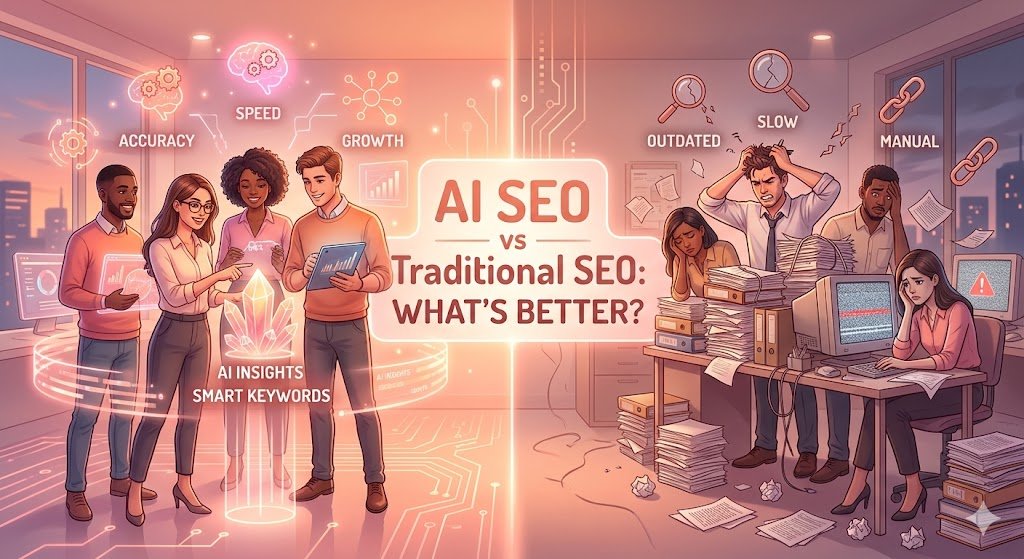
Q: Is AI in modern SEO replacing traditional SEO practices? AI is transforming and enhancing traditional SEO, not replacing it. The fundamentals — quality content, strong backlinks, technical health, good user experience — remain central. AI makes executing those fundamentals faster, smarter, and more scalable.
Q: Does using AI tools for SEO violate Google’s guidelines? No. Google evaluates content quality and user value, not production methods. AI-assisted content that is high quality, accurate, and genuinely useful to readers is treated the same as equivalent human-written content.
Q: What is the most important AI tool for SEO in 2026? There’s no single answer — the most valuable tool depends on your biggest opportunity. For most businesses, a comprehensive platform like Semrush or Ahrefs combined with a content optimization tool like Surfer SEO or Clearscope provides the highest baseline return.
Q: How does AI affect local SEO specifically? AI has made local SEO more sophisticated and scalable, enabling automated Google Business Profile optimization, review sentiment analysis, competitor tracking across multiple locations, and hyper-local content strategies that would be impossible to execute manually.
Q: How long does it take to see results from an AI-powered SEO strategy? The same timeline applies as with traditional SEO — typically 4–6 months for meaningful organic traffic improvements. AI accelerates the research, optimization, and auditing phases, but Google’s ranking algorithms still require time to recognize and reward quality improvements.
This article is for informational purposes only. Tool features, pricing, and Google algorithm details are accurate as of June 2026 and subject to change.