The short answer: AI digital marketing agency pricing in 2026 ranges from $1,000/month for entry-level retainers to $50,000+/month for enterprise AI systems — in both the USA and UK. What you pay depends on automation depth, strategy complexity, and whether the agency is truly AI-native or just using AI-flavored language to justify old-school fees.
This guide cuts through the noise. Whether you’re a startup founder deciding between freelancers and an agency, or a scaling business ready to invest in full-funnel automation, here’s exactly what AI digital marketing agency pricing looks like in 2026 — broken down by tier, country, service, and ROI.
What Is the Average Cost of an AI Digital Marketing Agency in 2026 (USA vs UK)?
In the USA, monthly AI digital marketing agency pricing ranges average $3,000–$15,000 for growth-stage businesses. In the UK, comparable services run £2,500–£12,000/month. Enterprise-level AI marketing systems push $25,000–$50,000+/month on both sides of the Atlantic.
These numbers are more nuanced than a single headline figure. The “AI” label in 2026 spans a huge range — from agencies using ChatGPT to write blog posts (cheap) to firms building custom large language model pipelines integrated into your CRM, ad stack, and analytics layer (expensive, and worth it if done right).
Here’s a quick snapshot of where the market sits:
| Tier | USA Monthly Cost | UK Monthly Cost |
|---|---|---|
| Entry-level / Startup | $1,000 – $3,000 | £800 – £2,500 |
| Mid-market / Growth | $3,000 – $10,000 | £2,500 – £8,000 |
| Scale-up / Advanced | $10,000 – $25,000 | £8,000 – £20,000 |
| Enterprise AI Systems | $25,000 – $50,000+ | £20,000 – £40,000+ |
Related read: How to evaluate an AI marketing agency before you hire one | AI marketing ROI benchmarks for 2026
Why Do AI Driven Digital Marketing Agency Prices Vary So Much Between Providers?
Pricing varies because “AI digital marketing” means wildly different things. One agency runs your ads through an AI dashboard. Another builds custom machine learning workflows that autonomously optimize your entire funnel. Same label — completely different value and cost structure.
The five biggest pricing drivers are:
1. Automation depth. Are they using off-the-shelf AI tools (Jasper, Surfer SEO, Madgicx)? Or are they building bespoke automation pipelines? Custom = more expensive, more valuable.
2. Strategy vs. execution ratio. Strategy-heavy engagements cost more. Execution-only packages are cheaper but create dependency without leverage.
3. Tool stack and integrations. An AI driven digital marketing agency running your ads through standard Meta Business Suite charge less than those connecting your CRM, Klaviyo, GA4, and a predictive analytics layer into one automated system.
4. Team model. A small AI-native team with senior strategists and automation engineers costs differently than a 50-person legacy agency with a “Head of AI” tacked on their website.
5. Niche and competition level. SaaS, finance, and e-commerce in competitive markets demand more sophisticated (and expensive) AI infrastructure than a local service business.
What Services Are Included in AI Digital Marketing Agency Pricing?
A full-service AI digital marketing retainer in 2026 typically includes AI SEO, paid media management, AI-generated content systems, CRM automation, and analytics/reporting. What’s included at each price point varies significantly — always ask for a service matrix before signing.
Here’s what a well-structured AI marketing agency should deliver:
AI SEO (Content + Entity Optimization)
Building topical authority through AI-accelerated content production, entity-based optimization, and programmatic SEO infrastructure. Expect this as a core service in any retainer above $3,000/month. See AI SEO agency pricing breakdown for more.
AI Paid Ads Management (Google, Meta, LinkedIn)
Smart bidding strategy, audience modelling, creative testing at scale, and AI-driven performance optimization across platforms. This is table stakes. The real differentiator is whether they’re doing genuine predictive budget allocation or just running auto-bidding campaigns.
AI Content Generation Systems
Not just “writing content with AI” — building a content engine: brief generation, draft creation, human review, SEO scoring, and publishing workflows. The best agencies build this as infrastructure you own, not a content output you rent.
AI CRM & Automation Workflows
Lead scoring, automated nurture sequences, lifecycle stage triggers, and personalization at scale. Agencies offering this at the $5,000+/month level typically integrate with HubSpot, Salesforce, or ActiveCampaign.
AI Analytics & Predictive Reporting
Beyond dashboards — predictive models that identify which campaigns will scale, which audiences are about to convert, and where your budget is leaking. Rare below $10,000/month but increasingly standard at scale.
Is an AI Marketing Agency Cheaper or More Expensive Than a Traditional Agency?
AI agencies are cheaper at the execution layer — content, ads, and reports cost less to produce with AI. But the strategy layer commands the same or higher fees. Net result: better output per dollar, not necessarily a lower invoice.
Traditional agency pricing is built around human hours. A 10-person team at a London or New York agency carries enormous overhead — office space, management layers, account coordinators who add process but not output. That overhead is baked into your retainer.
AI-native digital marketing agencies run leaner. A four-person AI agency in 2026 can genuinely outperform a 20-person traditional agency — but they’ll still charge for senior strategic thinking. The savings come in production speed and iteration cycles, not in strategy fees.
The real cost comparison:
| Cost Type | Traditional Agency | AI-Native Agency |
|---|---|---|
| Content production (10 articles/month) | $4,000 – $8,000 | $1,500 – $3,500 |
| Paid ads management | $2,000 – $5,000 | $1,500 – $4,000 |
| SEO strategy + execution | $3,000 – $7,000 | $2,500 – $6,000 |
| Reporting & analytics | $1,000 – $2,500 | $500 – $1,500 |
| Total monthly | $10,000 – $22,500 | $6,000 – $15,000 |
Related: AI marketing agency vs hiring in-house: 2026 comparison
How Much Should Startups Budget for AI-Driven Marketing Per Month?
Startups should budget $1,500–$4,000/month as a realistic minimum for meaningful AI marketing activity in 2026. Below $1,000/month, you’re buying tools, not strategy. Above $5,000/month early-stage, you’re likely over-investing before product-market fit.
Here’s the startup-stage budget framework:
Pre-revenue / Early Stage ($1,000–$2,000/month)
Focus: AI SEO content foundation + one paid channel (usually Google or Meta). Goal: traffic and lead data collection. Expect an agency to run a lean AI content operation and basic paid acquisition. Don’t expect full-funnel automation here.
Post-seed / Growing Revenue ($2,500–$5,000/month)
Focus: Paid acquisition scaling + SEO momentum + email automation setup. This is where AI agencies start adding real leverage — testing faster, optimizing ad creative at higher volume, building your first automated lead nurture sequences.
Series A / Scaling ($5,000–$15,000/month)
Full-funnel AI activation: multi-channel ads, content systems, CRM integration, and predictive analytics. At this stage, your agency should be building infrastructure that compounds — every month gets more efficient, not just more active.
Pro tip: Never sign a long-term contract before seeing 60 days of results data. Any legitimate AI marketing agency will offer this flexibility.
What Pricing Models Do AI Marketing Agencies Use?
The three dominant pricing models in 2026 are monthly retainers (most common), performance-based fees (highest risk, highest reward), and hybrid models (retainer + performance bonus). Project-based pricing is used for one-time builds like AI content systems or automation setup.
Monthly Retainer
The standard. You pay a fixed fee for a defined scope of services each month. Predictable for budgeting, but requires clear KPIs in the contract or scope creep becomes expensive fast.
Performance-Based Pricing
The agency earns a percentage of revenue generated, leads delivered, or ad spend managed (typically 10–20% of ad spend for paid media). Higher risk for the agency — higher potential upside for you if they’re confident in their systems.
Hybrid (Retainer + Performance Bonus)
Increasingly common in 2026. A lower base retainer ($1,500–$3,000) plus a performance kicker tied to CAC reduction, conversion rate improvement, or revenue growth. Aligns incentives properly.
Project / One-Time Build
Used for AI content system setup, marketing automation architecture, or SEO infrastructure builds. Typical range: $5,000–$25,000 for a complete build-out. Good for businesses who want to own the system rather than rent output.
See also: Marketing retainer agreements — what to look for in 2026
What Is a Fair ROI Expectation from an AI Digital Marketing Agency?
A well-run AI marketing agency should deliver 3x–6x ROI within 6–12 months of engagement. Efficiency improvements of 2x–4x in content production and ad management are realistic within 90 days. Revenue impact takes longer but should be measurable by month four.
ROI benchmarks you should hold your agency to:
Content Efficiency: AI-powered content operations should produce 3x–5x more output at the same budget versus traditional production. If you’re paying for AI content and not seeing volume + quality improvements, something is wrong.
Cost Per Acquisition (CPA) Reduction: AI optimization of paid campaigns typically delivers 15–40% CPA reduction within 3–6 months as machine learning models optimize on real conversion data.
Organic Traffic Growth: AI SEO strategies focused on topical authority and entity optimization should show measurable traffic gains within 90–120 days. If your agency can’t show a traffic trajectory by month three, the strategy is underperforming.
Lead Quality: Smarter audience targeting and intent-based content should improve lead-to-opportunity conversion rates by 20–35% in a well-optimized AI marketing setup.
The honest caveat: ROI depends heavily on your niche, your sales process, and the quality of the agency’s execution. AI is a multiplier — it amplifies good strategy and exposes bad strategy faster.
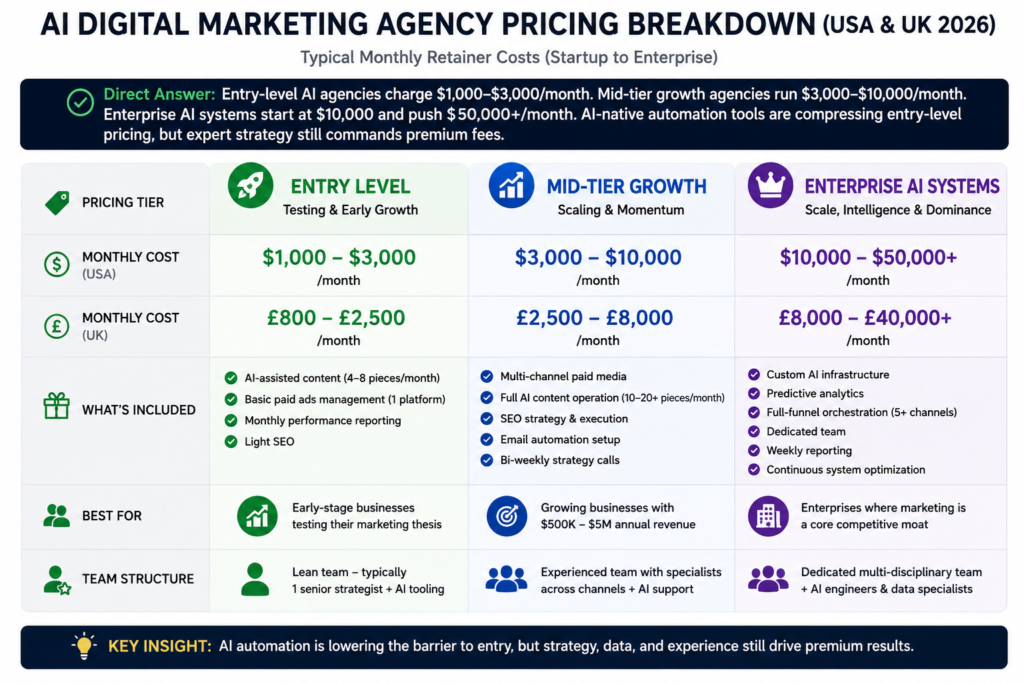
AI Digital Marketing Agency Pricing Breakdown (USA & UK 2026)
Typical Monthly Retainer Costs (Startup to Enterprise)
Entry-level AI agencies charge $1,000–$3,000/month. Mid-tier growth agencies run $3,000–$10,000/month. Enterprise AI systems start at $10,000 and push $50,000+/month. AI-native automation tools are compressing entry-level pricing, but expert strategy still commands premium fees.
Entry Level: $1,000–$3,000/month (£800–£2,500)
What’s included: AI-assisted content (4–8 pieces/month), basic paid ads management on one platform, monthly performance reporting, and light SEO. Typically suited to early-stage businesses testing their marketing thesis. Expect a lean team — possibly one senior strategist supported by AI tooling.
Mid-Tier Growth: $3,000–$10,000/month (£2,500–£8,000)
What’s included: Multi-channel paid media, full AI content operation (10–20+ pieces/month), SEO strategy and execution, email automation setup, and bi-weekly strategy calls. This is the sweet spot for growing businesses with $500K–$5M annual revenue.
Enterprise AI Systems: $10,000–$50,000+/month (£8,000–£40,000+)
What’s included: Custom AI infrastructure, predictive analytics, full-funnel orchestration across 5+ channels, dedicated team, weekly reporting, and continuous system optimization. Built for businesses where marketing is a core competitive moat, not just a growth lever.
Service-by-Service Cost Breakdown
Individual AI digital marketing services range from $500/month for basic AI SEO to $15,000+/month for full-stack AI growth systems. Knowing the component cost of each service helps you validate whether your agency’s retainer pricing is justified.
AI SEO (Content + Entity Optimization): $1,000–$5,000/month
Includes keyword research, topical cluster strategy, AI-assisted content briefs, and entity-based on-page optimization. Learn more about AI SEO pricing benchmarks from Ahrefs’ industry data.
AI Paid Ads Management (Google/Meta): $1,500–$6,000/month + ad spend
Management fees typically run 10–20% of monthly ad spend, with a minimum floor. AI-native agencies use dynamic creative testing, predictive bidding overlays, and automated audience expansion tools.
AI Content Generation Systems: $1,000–$4,000/month
Full content pipeline: AI drafts + human editorial review + SEO scoring + distribution. Quality varies enormously. Ask to see a content sample and the editorial process before committing.
AI CRM & Automation Workflows: $1,500–$5,000/month (setup) + $500–$2,000/month (management)
Lead scoring models, automated nurture sequences, lifecycle triggers. Setup cost is usually a one-time project fee; ongoing management is a lower monthly add-on.
AI Analytics & Predictive Reporting: $1,000–$4,000/month
Custom dashboards, attribution modelling, predictive budget allocation. At the high end, this includes custom ML models trained on your historical performance data.
USA vs UK Pricing Differences Explained
US AI marketing agencies generally charge 20–40% more than UK equivalents for comparable services. New York, San Francisco, and LA command the highest premiums. London follows closely. AI tooling is gradually compressing the regional pricing gap by reducing the human hours required.
Why US agencies charge more:
The US market has historically commanded higher rates due to larger average deal sizes, higher cost of living for talent, and greater demand from well-funded startups. An agency in NYC managing $500K/month in ad spend justifies premium fees. The same agency model in Manchester or Glasgow typically scales at lower rates.
UK market dynamics in 2026:
UK SMBs are particularly price-sensitive following several years of economic pressure. This has accelerated adoption of leaner AI-native agencies over larger traditional shop models. The result: genuinely competitive AI marketing talent available at 20–35% below US equivalents — without a quality compromise.
What AI tools are doing to regional pricing:
Platforms like HubSpot AI, Google Performance Max, and Meta Advantage+ are reducing the labour hours needed for execution tasks. This compression is felt most at the entry and mid tiers, where AI tooling now does what a junior team member used to do. Senior strategy, however, remains geographically priced.
Why AI Agencies Don’t Have Fixed Pricing
AI marketing agencies don’t publish fixed pricing because scope variability is enormous. The difference between “run our Google Ads with AI optimization” and “build an end-to-end AI growth system integrated with our CRM, content, and analytics stack” is a $20,000/month chasm in complexity and value.
The core variables that break fixed pricing:
Scope variability: A single-channel campaign management retainer has a defined scope. A multi-channel AI orchestration system with custom integrations does not — it evolves monthly as the system learns.
Data and tool stack complexity: Integrating AI tools into a simple WordPress site is different from integrating them into a custom-built e-commerce platform with five data sources and a proprietary CRM.
Human + AI hybrid model: The best AI agencies don’t replace humans — they combine senior strategists with AI systems. The ratio of human expertise to AI execution in your engagement drives cost.
Custom system building vs. task execution: Are they building you a marketing asset (a system that gets smarter over time)? Or executing tasks month-to-month? The former costs more upfront and delivers exponentially more long-term value.
What You Actually Get at Each Price Level
At $1,000–$3,000/month you get execution support with AI tools. At $3,000–$10,000/month you get a proper growth system. Above $10,000/month you get predictive AI infrastructure designed to scale. The gap between tiers is not just quantity — it’s strategic sophistication.
Basic Tier ($1,000–$3,000/month): AI-assisted content creation, one-channel paid ads, basic SEO, and monthly reporting. You’re buying time and tools. Strategy is lightweight.
Growth Tier ($3,000–$10,000/month): Full-funnel AI activation — multi-channel paid media, content operation, SEO momentum, email automation, and biweekly strategy. You’re buying a system with compounding returns.
Enterprise Tier ($10,000–$50,000+/month): Predictive AI, multi-channel orchestration, custom ML models, dedicated team, and proprietary system builds. You’re buying a competitive moat — marketing infrastructure that’s harder to replicate than any individual campaign.
What Determines AI Agency Pricing in 2026?
Level of Automation and AI Stack Used
The sophistication of an agency’s AI stack is the single biggest pricing driver. An agency using standard SaaS AI tools (Jasper, Surfer, Madgicx) costs far less than one building custom AI systems on OpenAI, Claude, or Gemini APIs with bespoke integration layers.
Off-the-shelf AI tools reduce cost but cap capability. They’re excellent for straightforward use cases — content volume, basic ad optimization, keyword research. Custom AI systems are architecturally different: they learn from your specific data, integrate with your proprietary workflows, and improve with every campaign cycle.
A simple way to evaluate: ask the agency “what percentage of your AI stack is custom-built vs. off-the-shelf tools?” If the answer is 100% off-the-shelf, the premium for “AI” in their name isn’t justified.
Depth of Strategy vs. Execution
Strategy-heavy engagements cost 40–80% more than execution-only packages. The difference is not just in the work — it’s in the accountability. A strategic partner owns your marketing results; an execution vendor delivers outputs. In 2026, AI has made execution cheap. Strategy is where the premium lives.
Execution-only AI marketing (content at volume, ads running on autopilot) is increasingly commoditized. Platforms like Google Performance Max and Meta’s Advantage+ automate large portions of ad execution directly. What you’re actually paying a premium AI agency for is the strategic layer that tells those systems what to optimize toward — and why.
Business Size and Revenue Stage
Startups pay $1,000–$3,000/month, SMEs pay $3,000–$10,000/month, and enterprise businesses pay $10,000–$50,000+/month. It’s not just about what you can afford — it’s about what complexity your business actually requires at each stage.
Early-stage businesses need speed and learning, not optimization. Over-investing in a sophisticated AI system before you have meaningful conversion data is a waste. The right AI marketing spend scales with your data volume — more data means AI can work harder and deliver more.
Revenue stage also affects pricing models. Investors in a Series A startup may push for performance-based agency agreements where cost tracks directly to revenue. Established businesses with stable revenue can justify larger fixed retainers for systemic capability-building.
Industry Competition Level
Finance, SaaS, legal, and e-commerce in competitive markets require more sophisticated AI marketing systems — and cost 30–60% more than lower-competition niches. Local service businesses typically sit at the lower end of the pricing spectrum.
Competitive industries require more iterations, faster optimization cycles, higher content quality thresholds, and more sophisticated audience modelling. AI amplifies effort — but in high-competition markets, it takes more effort at every layer. A personal injury law firm in New York competing against 500 other practices needs a different AI marketing engine than a niche B2B software tool targeting 2,000 potential buyers globally.
Agency Model: AI-Native vs Traditional + AI
AI-native agencies scale cheaper because their infrastructure isn’t built on human labour. Traditional agencies retrofitting AI onto existing team structures carry legacy overhead — and charge you for it. Know which type you’re hiring.
An AI-native agency in 2026 is built around automated systems with humans in oversight and strategy roles. Overhead is minimal. A traditional agency “adding AI” still has account managers, coordinators, and layers of process that exist to manage the human team — not to serve your results.
The tell: ask how the agency’s cost structure would change if their AI tools went offline for a month. An AI-native agency would scramble. A traditional agency with an AI veneer would barely notice.
Signs You Are Overpaying an AI Marketing Agency
No Clear Attribution to Revenue or Leads
If your agency can’t show you a direct line from their work to business outcomes — leads generated, revenue influenced, or CAC reduced — you are paying for activity, not results. Vanity metrics (impressions, followers, “reach”) are the oldest cover in the industry.
Every AI marketing engagement should have a dashboard connecting activity to pipeline. If you’re 90 days in and your monthly report is full of traffic charts and content output numbers but your sales team isn’t seeing more qualified leads, the system isn’t working. Demand attribution or demand a conversation about why it’s missing.
Generic AI Outputs Without Strategy
AI-generated content that could apply to any business in your industry, ad copy that doesn’t speak to your specific audience, or SEO articles with no differentiated point of view — these are signs your agency is running a production operation, not a marketing system. Automation without strategy is expensive noise.
The test: could your AI-generated blog posts have been written for your top three competitors with minor edits? If yes, they’re not AI-powered marketing. They’re AI-powered filler. Real AI marketing starts with positioning — then uses AI to execute at scale from a differentiated foundation.
Locked Long-Term Contracts Without Flexibility
Legitimate AI marketing agencies in 2026 operate on 30–90 day notice periods, not 12-month locked contracts. AI services should adapt monthly as data comes in. Long lock-in periods protect the agency, not you. Walk away from any contract longer than six months without performance milestones.
The AI marketing landscape changes quarterly. Strategies that worked in Q1 may need significant adjustment by Q3 as platform algorithms update, competitive landscapes shift, and new AI tools become available. Any agency confident enough in their results will offer flexibility — because their client results do the retaining.
Lack of Transparent Reporting Systems
If you can’t see your own campaign data in a live dashboard, something is wrong. Transparent reporting is the foundation of any AI marketing partnership. An agency hiding behind monthly PDF reports in 2026 is hiding underperformance.
Best-in-class AI marketing agencies build client-facing dashboards in Looker Studio, Databox, or custom analytics layers. You should be able to log in and see your KPIs in real time — not wait for a presentation. If your agency controls all the data access, they control the narrative about their own performance.
When Hiring an AI Agency Is Worth It
When You Need Full Funnel Automation
If you need ads, SEO, email, and CRM to work as one connected system — not three separate freelancers and two tools — an AI agency is almost certainly the right move. Integration is where AI agencies earn their fees.
Full-funnel automation means every touchpoint is connected: someone clicks an ad → lands on a conversion-optimized page → enters an AI-scored lead nurture sequence → gets flagged for sales outreach at the right lifecycle moment. Building this as a single integrated system is complex. A capable AI agency does this as standard. Most freelancers and in-house teams cannot.
When You Don’t Have an Internal Marketing Team
An AI marketing agency can replace the functional output of a 3–5 person marketing team at a fraction of the cost. It can’t fully replace strategic leadership, but it can execute at a level that outpaces most in-house teams without the overhead of salaries, benefits, and management.
The comparison: a marketing manager ($60,000–$90,000/year in the UK), a content specialist (£35,000–£55,000/year), and a paid ads manager (£45,000–£70,000/year) totals over £140,000/year in salary alone — before tools, training, and management costs. A $5,000–$8,000/month AI agency retainer delivers comparable output at roughly half the all-in cost.
When Speed of Scaling Matters More Than Cost
AI agencies operate faster than in-house teams or freelancer networks. If you’re entering a competitive market, launching a new product, or trying to establish organic authority before a funded competitor does — the speed advantage of an AI agency is worth paying for.
In-house teams need time to hire, onboard, and ramp. Freelancers need briefing, management, and coordination. A capable AI marketing agency can be producing results within 30 days of onboarding. In a fast-moving market, that month can be the difference between category leadership and irrelevance.
Future of AI Digital Marketing Agency Pricing (2026–2030)
Prices Will Split Into Two Extremes
By 2028–2030, AI marketing pricing will bifurcate into ultra-cheap AI automation subscriptions ($500–$2,000/month) and high-value AI strategy consultancies ($20,000–$100,000+/month). The mid-market is at risk of being squeezed from both directions.
The commoditization of AI execution tools is accelerating. Platforms like HubSpot, Semrush, and emerging AI-native marketing suites are packaging sophisticated automation into subscription tools that any business can deploy without an agency. The agencies that survive will be those delivering strategic intelligence that tools can’t replicate: market positioning, brand differentiation, and genuine growth architecture.
Human + AI Hybrid Models Will Dominate
Pure AI agencies (no human oversight) will underperform. Pure human agencies will become uncompetitive on cost. The dominant model through 2030 will be small, senior human teams deploying sophisticated AI systems — with humans accountable for strategy and AI accountable for execution at scale.
This shift is already visible. The most effective AI marketing agencies in 2026 are not replacing strategists — they’re making strategists 10x more leveraged. A senior growth marketer supported by AI tooling can now manage the equivalent of five campaign portfolios simultaneously. That leverage is the product. The AI is the infrastructure.
AI Digital Marketing Agency Pricing Becomes Subscription-Based Systems
Direct answer: The retainer model is evolving into “marketing as a service” — subscription-based AI systems that deliver specific outcomes (X leads per month, Y% traffic growth) rather than activities (X pieces of content, Y ad campaigns). Outcome-based pricing will dominate by 2028.
This is a fundamental shift from buying inputs (agency hours, content pieces, ad management) to buying outputs (pipeline, traffic, revenue). AI makes this model viable because the systems are predictable enough to price against outcomes. For clients, it aligns incentives perfectly. For agencies, it demands genuine confidence in their systems — and weeds out those who can’t deliver.
Final Decision Framework: How Much Should YOU Pay?
Budget Based on Revenue Stage
Direct answer: A simple rule — spend 7–15% of current revenue on marketing at the growth stage, with 40–60% of that budget allocated to your AI agency retainer. Earlier stage: prioritize learning and testing over scale. Later stage: prioritize system-building and optimization over new channel exploration.
Startup (pre-$1M revenue): Test one or two channels with an AI agency at $1,500–$3,000/month. Prioritize learning what converts. Don’t build complex systems before you have conversion data.
Growth ($1M–$10M revenue): Invest $3,000–$8,000/month in a full-funnel AI system. This is where compounding starts. Every month of AI learning improves the next month’s performance.
Scale ($10M+ revenue): Allocate $10,000–$25,000+/month for predictive AI infrastructure. At this stage, marketing should be a competitive moat — not just a growth function. Custom AI systems, proprietary data assets, and integrated martech stacks are the plays.
ROI-First Pricing Rule
Pay for systems, not hours. The right question is not “how much does this agency cost?” — it’s “what will my cost per acquisition look like in six months compared to today?” An AI-driven digital marketing agency costing $8,000/month that reduces your CAC by 40% on $100,000/month ad spend is worth every dollar. An agency at $2,000/month producing content nobody reads is not.
The four numbers every AI marketing engagement should track:
- Cost Per Acquisition (CPA) — is it falling over time as AI optimizes?
- Content ROI — are organic channels generating qualified pipeline?
- Funnel Velocity — are leads converting faster with AI nurture sequences?
- Revenue Attribution — what percentage of closed revenue is touched by AI-driven marketing?
If your agency can’t report these, or won’t — that’s your answer.
Summary: USA & UK AI Marketing Agency Pricing at a Glance (2026)
| Factor | Entry | Growth | Enterprise |
|---|---|---|---|
| Monthly cost (USD) | $1,000–$3,000 | $3,000–$10,000 | $10,000–$50,000+ |
| Monthly cost (GBP) | £800–£2,500 | £2,500–£8,000 | £8,000–£40,000+ |
| Best for | Startups, testing | SMEs scaling | Large businesses |
| Services included | Ads + content basics | Full funnel AI | Predictive AI + custom systems |
| Contract flexibility | 30–90 day notice | 30–90 day notice | 60–90 day notice |
| Expected ROI timeline | 3–6 months | 2–4 months | 1–3 months |
The bottom line: AI digital marketing agency pricing in 2026 is not about finding the cheapest option. It’s about finding the right system for your stage — and holding that system accountable to business outcomes, not activity metrics. The right agency pays for itself. The wrong one just has a better-looking report.
Ready to evaluate your options? Download the AI marketing agency vetting checklist | Compare AI SEO agency pricing | Request a growth audit
Sources and further reading: Ahrefs Marketing Agency Pricing Research | HubSpot State of Marketing 2026 | Statista Digital Advertising Spend Data | Search Engine Journal on AI Marketing Trends